Last updated: July 7, 2026 · By Stas Bojoukha, Founder of Compyl
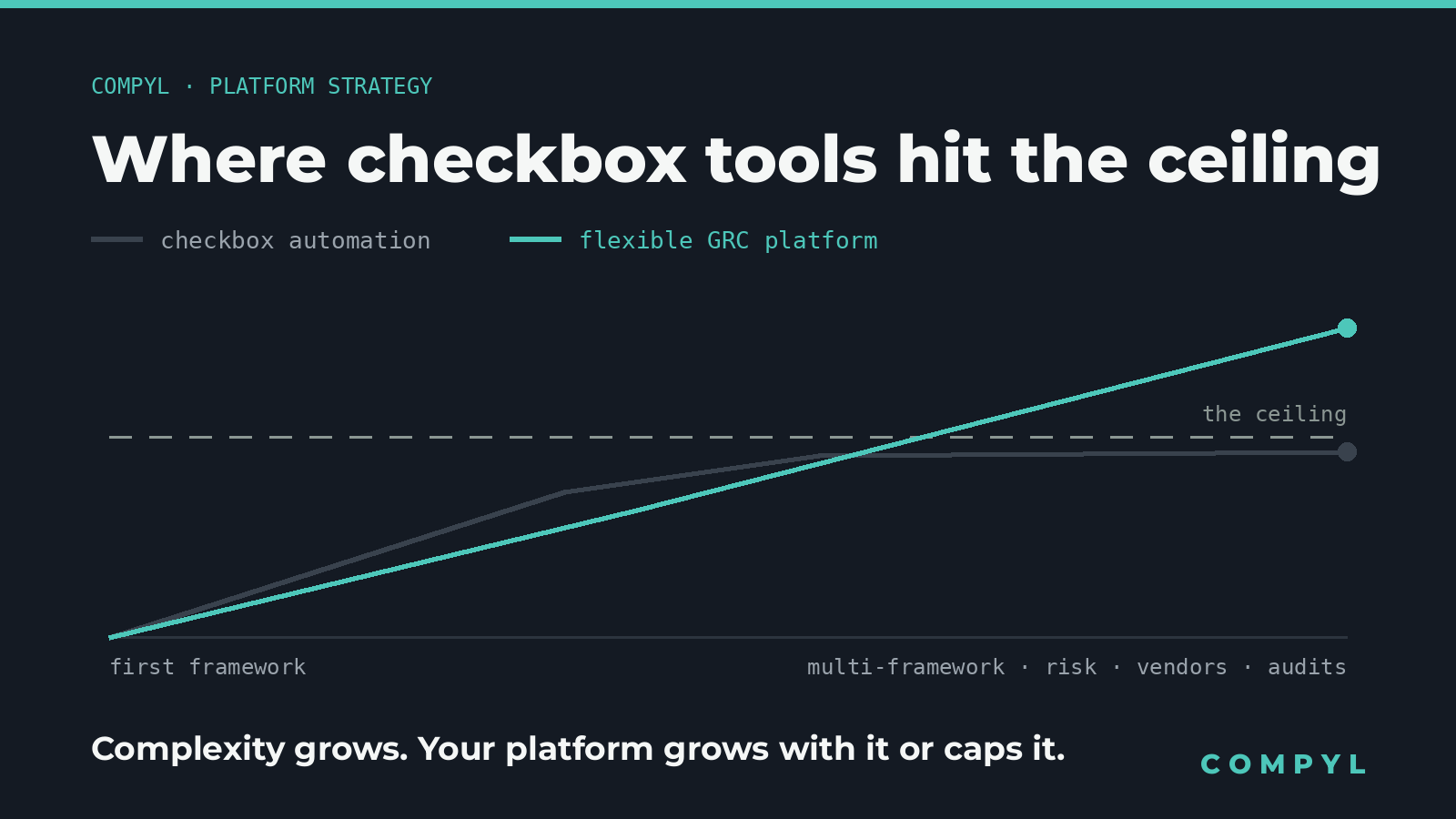
Compliance automation tools get you certified; GRC platforms run your risk and compliance program. Automation tools like Vanta and Drata automate evidence collection for specific frameworks such as SOC 2 and ISO 27001. GRC platforms manage the whole program: multiple frameworks, enterprise risk, third-party risk, policies, and audits in one system. You outgrow the first category when your program stops being about a certificate and starts being about risk.
What compliance automation tools do well
Credit where due: compliance automation changed this market for the better. A seed-stage company can connect its cloud stack and reach SOC 2 in weeks for $10K–$50K a year — work that used to take consultants and quarters. If you need one or two certifications to unblock sales and nothing more, an automation tool is the right buy, and pretending otherwise would be dishonest.
The five signs you’ve hit the ceiling
- Your framework count keeps growing. SOC 2 became SOC 2 + ISO 27001 + HIPAA + a state privacy law. Preset framework templates start fighting each other, and you’re duplicating evidence across them instead of mapping one control to many requirements.
- Risk stopped fitting in a spreadsheet. The board is asking for a risk register, quantified exposure, and trend lines. Automation tools track control status, not enterprise risk — so the real risk program quietly moves back into Excel next to the tool you’re paying for.
- Vendors became your biggest exposure. Basic questionnaire sending isn’t third-party risk management. When you need vendor tiering, continuous vendor monitoring, and contract-linked risk data, you’re describing a platform capability.
- The integrations tell you less than they seem to. Many automation integrations are thin API checks: the tool asks a system “are you okay?” and records the yes. Risks that live in the overlap between systems — the offboarded employee with a still-active access key — never surface, because no single-system check can see them. This is the difference between monitoring controls between audits and pinging endpoints.
- You’re customizing around the tool instead of in it. Every workflow that lives in email and spreadsheets because the tool can’t model it is a vote for the next class of software.
Compliance automation vs. GRC platform: side by side
| Dimension | Compliance automation | GRC platform |
|---|---|---|
| Primary job | Get and keep certifications | Run the risk and compliance program |
| Frameworks | Preset templates, added one at a time | Cross-mapped controls satisfying many frameworks at once |
| Risk management | Control pass/fail status | Risk register, scoring, and quantification in dollars |
| Third-party risk | Basic questionnaires | Vendor tiering, continuous monitoring, contract linkage |
| Integrations | Broad but shallow status checks | Full data ingestion and cross-system analysis |
| Configurability | Opinionated defaults | Custom workflows, fields, dashboards — ideally no-code |
| Typical cost | $10K–$50K/yr | $50K–$200K/yr mid-market |
When switching costs less than staying
The visible cost of staying is a second tool: teams keep the automation tool for certification and buy point solutions for risk, vendors, and policies. The invisible cost is the gaps between those tools — the same siloed-data problem that causes findings to surface at audit time instead of the day they happen. By the time a team runs three point tools plus spreadsheets, a consolidated platform is usually cheaper in both dollars and analyst hours. For a fuller view of what’s available in each class, see our comparison of the 7 best GRC platforms in 2026.
How to migrate without losing your certification
- Run both tools through one audit cycle. Keep the automation tool as evidence-of-record while the platform ingests your systems and rebuilds the control library.
- Map controls before you move evidence. A platform with cross-framework mapping will collapse your duplicated per-framework controls into one tested set.
- Move the risk register and vendor program first. These usually live in spreadsheets anyway, so there’s no continuity risk — and they show platform value fastest.
- Cut over after the audit, not before it. Nobody ever regretted scheduling a migration for the week after the report was issued.
Frequently asked questions
Is Vanta a GRC platform?
Vanta is best categorized as a compliance automation tool: excellent for certification-driven work like SOC 2 and ISO 27001, with expanding but lighter coverage of enterprise risk, third-party risk, and custom program workflows compared with dedicated GRC platforms.
When should a company move from compliance automation to a GRC platform?
The common trigger is managing three or more frameworks, plus at least one program need beyond certification — a real risk register, deep vendor management, or board-level risk reporting. Companies in the $50M–$250M revenue range hit this point most often.
Can you run compliance automation and a GRC platform together?
Yes, and it’s the standard migration pattern: keep the automation tool through the current audit cycle while standing up the platform, then consolidate. Running both permanently reintroduces the tool sprawl a platform is supposed to eliminate.
How much more does a GRC platform cost than compliance automation?
Buyer guides put automation tools at $10K–$50K per year and mid-market GRC platforms at $50K–$200K. The honest comparison includes what the automation tool doesn’t cover: the point solutions and analyst hours spent filling its gaps.
About the author: Stas Bojoukha is the founder of Compyl and spent 20+ years as a CISO across financial services, real estate, and energy. Compyl is built for the teams in the middle: past the checkbox stage, with no appetite for a 12-month enterprise rollout.
Outgrowing your compliance tool? See how teams migrate to Compyl.