Last updated: July 7, 2026 · By Stas Bojoukha, Founder of Compyl
To answer security questionnaires in hours instead of weeks, build a maintained answer library from your live compliance data, use AI to draft responses against it, and route only the exceptions to humans for review. The teams that do this treat questionnaires as a sales-velocity problem, not a compliance chore — because that is what they have become.
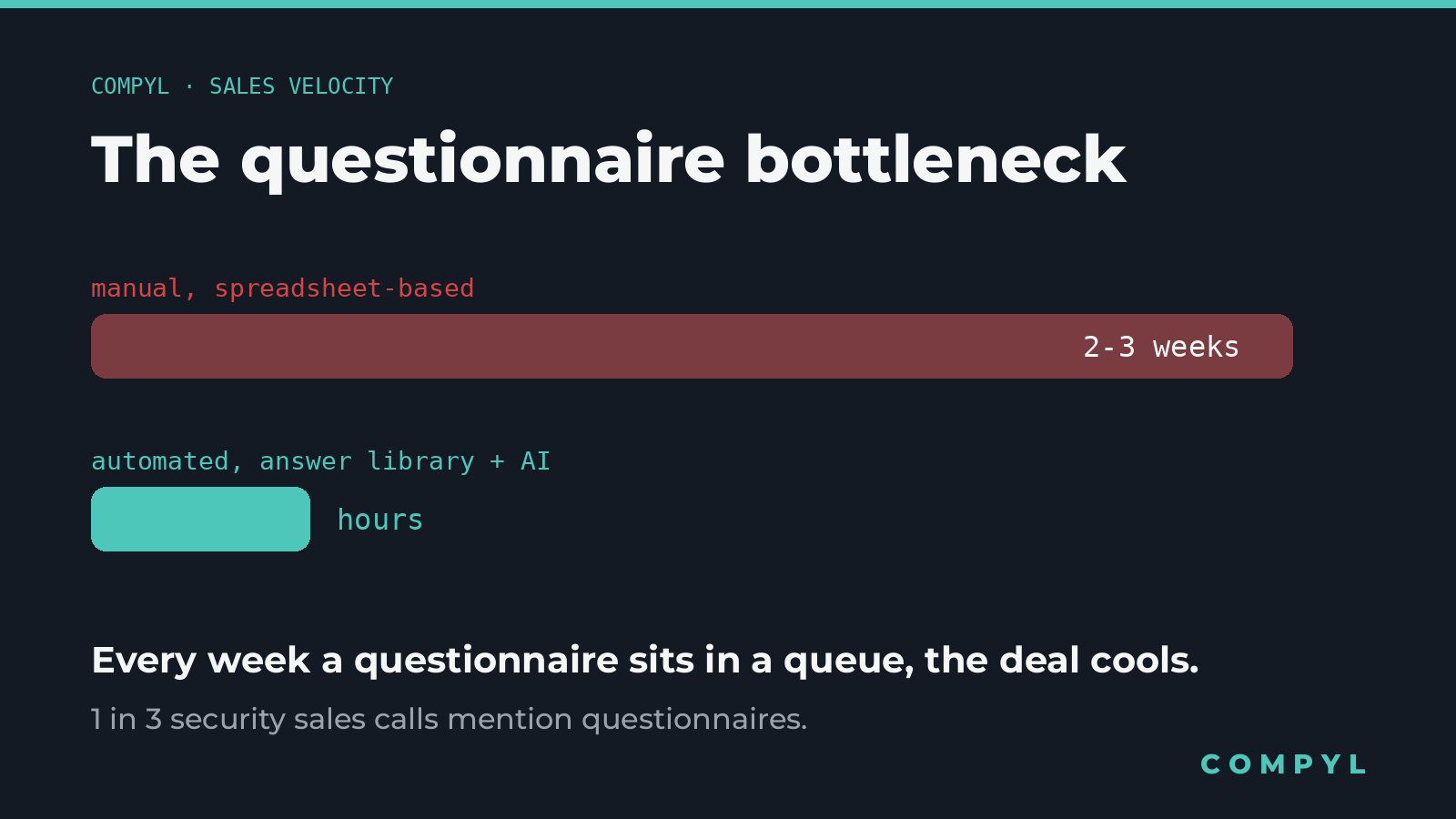
The scale of the problem is easy to underestimate. In Compyl’s analysis of more than 1,500 recorded sales conversations, security questionnaires came up in a third of all calls, and third-party risk broadly in 38% — the most common topic in security sales, ahead of any product feature.
Why questionnaires take weeks
The typical flow: sales forwards a 300-question spreadsheet, a security engineer copies answers from the last spreadsheet that looked similar, half the answers are stale because the environment changed, three people get pulled in to verify, and two or three weeks later the deal gets its answers. Multiply by every deal in the pipeline. The cost isn’t just analyst hours — it’s deal momentum. A questionnaire sitting in a queue is a buying decision cooling off, and the vendor who answers in a day frames the security conversation for everyone who answers after them.
The 5-part system for same-day questionnaires
- Build one answer library, tied to live data. The root cause of slow questionnaires is that answers live in old questionnaires. Maintain one canonical library where each answer maps to a control in your compliance platform — when the control changes, the answer flags itself stale instead of waiting to be wrong in front of a prospect.
- Let AI draft, not decide. Modern questionnaire automation reads the incoming file — portal, spreadsheet, or PDF — matches each question against your library, and drafts responses with confidence scores. High-confidence answers pass through; low-confidence ones queue for a human. Drafting is the 80% that shouldn’t consume your team.
- Route exceptions with ownership and deadlines. The questions AI can’t answer are the ones that matter — new capabilities, unusual scope, legal language. Those need a named owner and an SLA, not a group email thread.
- Publish a trust center to prevent questionnaires. A public page with your certifications, subprocessors, and security overview answers the first hundred questions before they’re asked. Many buyers will accept it in place of a custom questionnaire entirely.
- Feed every new answer back into the library. Each questionnaire should make the next one faster. If your completion time isn’t trending down, answers are leaking back into spreadsheets.
Manual vs. automated questionnaire response
| Dimension | Manual process | Automated system |
|---|---|---|
| Turnaround | 2–3 weeks typical | Hours to 1–2 days |
| Source of answers | The last spreadsheet that looked similar | Canonical library tied to live control data |
| Staleness | Discovered by the prospect | Flagged automatically when controls change |
| Security team load | Every question, every time | Exceptions only |
| Sales impact | Deals stall in security review | Security review becomes a differentiator |
Questionnaires are a posture question in disguise
Here’s the deeper shift: buyers send questionnaires because they can’t see your posture. The long-term fix isn’t faster form-filling — it’s being the vendor whose answers come from live data. The question behind every questionnaire is the one buyers now ask directly: how do you monitor your controls between audits? Answer that with live evidence and the questionnaire becomes paperwork instead of an investigation.
Frequently asked questions
How long should a security questionnaire take to complete?
With a maintained answer library and AI drafting, a standard 200–300 question questionnaire should take hours of elapsed time and under an hour of human review. Multi-week turnarounds are a process symptom, not a workload inevitability.
Can AI answer security questionnaires accurately?
AI is highly accurate at matching questions to an existing, well-maintained answer library and drafting responses from it. It is not a substitute for human review on novel, legal, or scope-sensitive questions — the right design is AI drafting with human approval, not AI autopilot.
What is a trust center?
A trust center is a public or gated page publishing your certifications, security practices, subprocessors, and compliance documentation. It preempts questionnaires by giving buyers self-serve answers, and many will accept it in place of a custom questionnaire.
Do security questionnaires actually affect deal velocity?
Yes. Questionnaires come up in roughly a third of security sales conversations, and they sit directly on the critical path to signature: a two-week questionnaire turnaround is two weeks added to every affected deal cycle.
About the author: Stas Bojoukha is the founder of Compyl and spent 20+ years as a CISO answering these questionnaires by hand. Compyl automates questionnaire response from live compliance data — answer library, AI drafting, and trust center in one platform.
See how teams answer questionnaires in hours with Compyl — book a demo.