Last updated: July 7, 2026 · By Stas Bojoukha, Founder of Compyl
To monitor controls between audits, connect your security and business systems to a platform that continuously tests each control against its expected state, flags drift the moment it appears, and keeps evidence audit-ready automatically. This practice, called continuous control monitoring (CCM), replaces the point-in-time snapshot of an annual audit with real-time assurance.
That answer matters because the question itself has changed. Buyers no longer ask “are you SOC 2 certified?” They ask “how do you monitor your controls between audits?” If your answer is “we check annually,” you are telling them you fly blind for 364 days a year.
Live webinar · July 16: Annual Audits Are Dead — Compyl CEO Stas Bojoukha and Mastermind CEO David Forman on what replaces the annual audit. 60 minutes, live Q&A, recording sent to every registrant.
Why annual audits no longer work
An annual audit is a photograph of your security posture on one day of the year. It worked when infrastructure changed quarterly. Today, cloud environments change hourly: new vendors are onboarded, permissions are granted, configurations are updated, and employees come and go every single week.
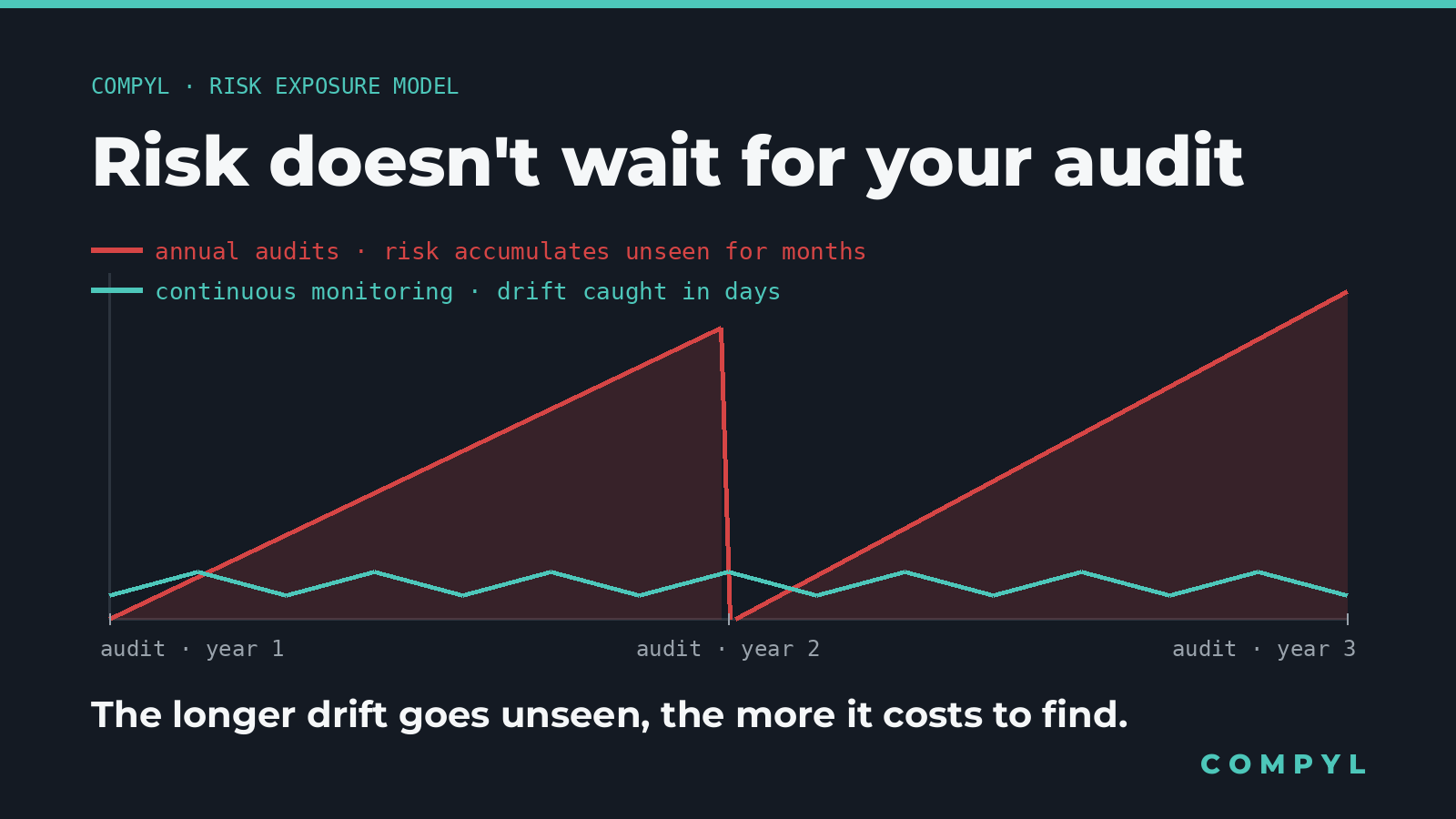
The gap between audits is where risk lives. According to IBM’s Cost of a Data Breach Report 2025, organizations took an average of 241 days to identify and contain a breach — 158 days just to find it. Breaches contained in under 200 days cost an average of $3.61M; those that ran longer cost $5.49M, a $1.88M difference driven almost entirely by how fast problems are detected.
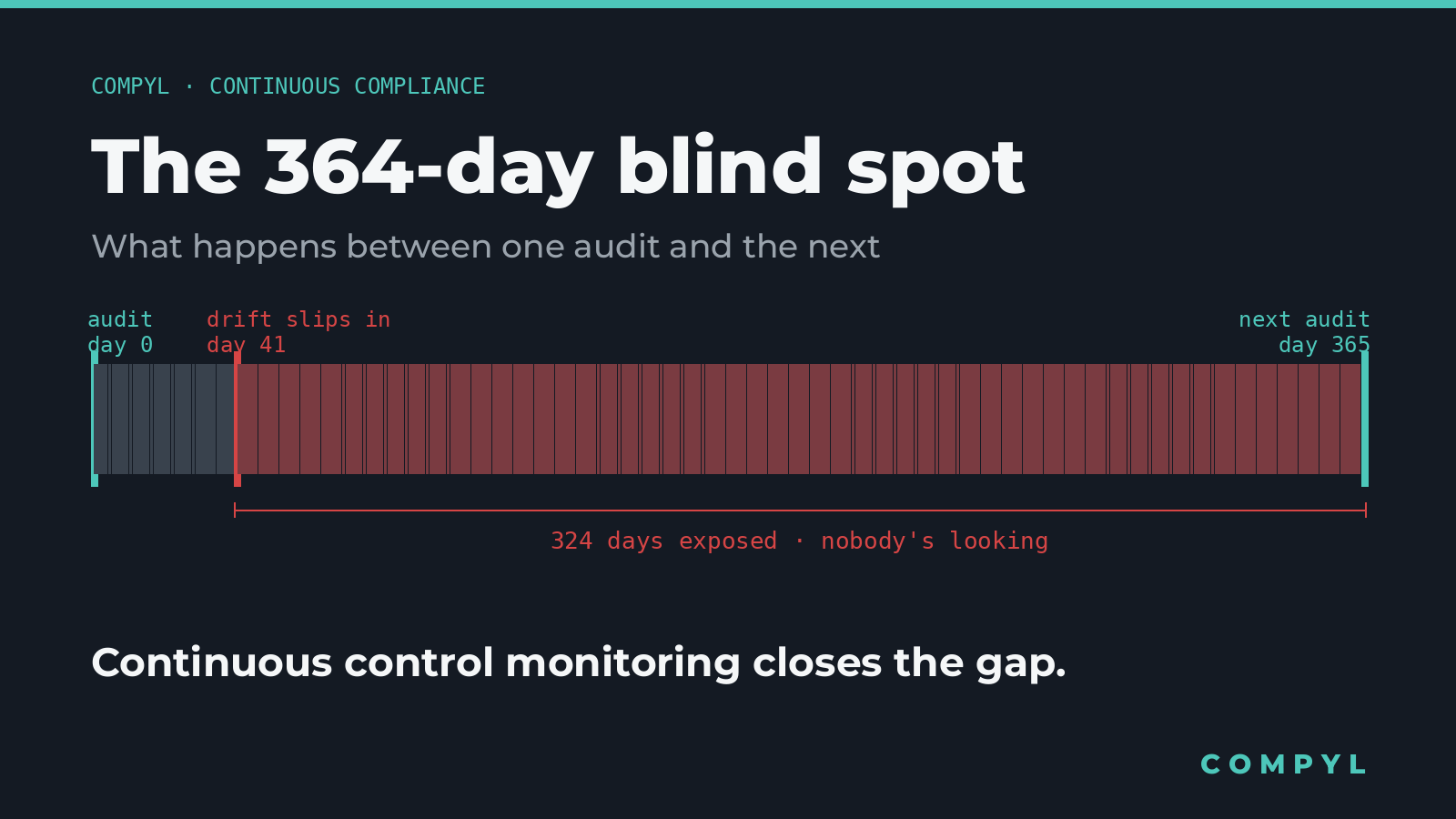
Here is what that looks like in practice. A control passes its audit on day 0. On day 41, an engineer changes an access configuration and a control silently drifts out of compliance. Nobody is looking, because the next scheduled check is 324 days away. The drift is found at the next audit — after nearly a year of exposure. Every audit-cycle organization has some version of this story; most just have not found theirs yet.
What is continuous control monitoring?
Continuous control monitoring (CCM) is the automated, ongoing testing of security and compliance controls against their expected state. Instead of sampling evidence once a year, a CCM platform pulls live data from your systems, evaluates each control continuously, and alerts the owner the moment a control drifts out of compliance.
The critical distinction is between monitoring a system and monitoring across systems. A single tool can report that it is healthy while a risk sits in the overlap between two tools — an off-boarded employee removed from your identity provider but still holding an active access key in your code repository, for example. Effective CCM ingests complete data from every connected system and evaluates controls across them, not one silo at a time.
Annual audits vs. continuous monitoring: what’s the difference?
| Dimension | Annual audit | Continuous control monitoring |
|---|---|---|
| Assurance | Point-in-time snapshot, valid the day it was taken | Real-time, valid right now |
| Evidence | Screenshots and spreadsheets collected in a 3-month scramble | Live data pulled automatically from connected systems |
| Drift detection | At the next audit, often months later | The day it happens |
| Team impact | Audit season consumes the security team | Steady, largely automated workload |
| Scope | Sampled controls, sampled evidence | Every control, every day, across systems |
| Answer to a buyer | “We passed our audit” | “Here is our posture today” |
How do you monitor controls between audits?
Moving from annual snapshots to continuous assurance is a process change as much as a tooling change. The sequence that works:
- Inventory your controls and map them to frameworks. One control should satisfy many requirements — SOC 2, ISO 27001, HIPAA — so you test it once and report it everywhere.
- Connect your systems directly. Integrations should pull complete, live data from your identity provider, cloud infrastructure, HR system, and vendor stack — not thin API pings through middleware that only check whether a service responds.
- Define the expected state for each control. What does “passing” mean, in data? Codify it. Pre-built control blueprints accelerate this dramatically; writing hundreds of tests from scratch is where most DIY programs stall.
- Automate the tests to run continuously. Critical controls should be evaluated at least daily; high-change systems, continuously. A control test that runs annually is an audit, not monitoring.
- Route drift to a human owner with a deadline. Detection without ownership is noise. Every failed check should open a task, assign an owner, and escalate if it ages — automation with a human in the loop, not instead of one.
- Keep evidence continuously audit-ready. If your controls are tested daily and evidence is captured automatically, the audit stops being an event. Auditors review what already exists instead of requesting what must be assembled.
The question buyers are asking now
This shift is not driven by regulators alone — it is driven by customers. In Compyl’s analysis of more than 1,500 recorded sales conversations with security vendors, third-party risk came up in 38% of calls, and security questionnaires in a third. Buyers have learned that a certificate proves a company passed a test once. What they want to know is what happens the other 364 days.
That makes continuous monitoring a revenue capability, not just a security one. Teams that can answer a security questionnaire in hours — with live posture data instead of last year’s audit report — close deals faster than teams that assemble answers by hand. Compliance gets you into the conversation. Demonstrated posture wins it.
Frequently asked questions
What is control drift?
Control drift is when a control that previously passed moves out of its compliant state without anyone deciding — or noticing. Common causes include configuration changes, new integrations, permission grants, and employee turnover. Drift is invisible to annual audits until the next audit cycle.
How often should security controls be monitored?
Continuously where the data source supports it, and at minimum daily for critical controls such as access management, encryption, and vendor risk. Quarterly or annual checks leave months of undetected exposure between tests.
Does SOC 2 require continuous monitoring?
SOC 2 Type II evaluates controls over a review period, typically 3 to 12 months, and auditors expect evidence that controls operated throughout that window. Continuous monitoring is the most reliable way to produce that evidence — and increasingly, customers expect it regardless of what the framework technically requires.
What is the difference between continuous compliance and continuous control monitoring?
Continuous control monitoring is the mechanism: automated, ongoing testing of controls. Continuous compliance is the outcome: a state in which your organization can demonstrate its posture at any moment, not just at audit time. You reach continuous compliance by implementing CCM.
Can a small security team run continuous monitoring?
Yes — small teams benefit most. Automation does the repetitive evidence collection and testing that would otherwise consume analyst hours, and the team handles only the exceptions. The alternative, manual annual audit prep, is far more expensive in team time than maintaining an automated program.
About the author: Stas Bojoukha is the founder of Compyl and spent 20+ years as a CISO across financial services, real estate, and energy before building the GRC platform he always wanted as a practitioner. Compyl connects 125+ systems, tests controls continuously, and keeps organizations audit-ready every day of the year.
See how Compyl monitors controls between audits — book a demo.