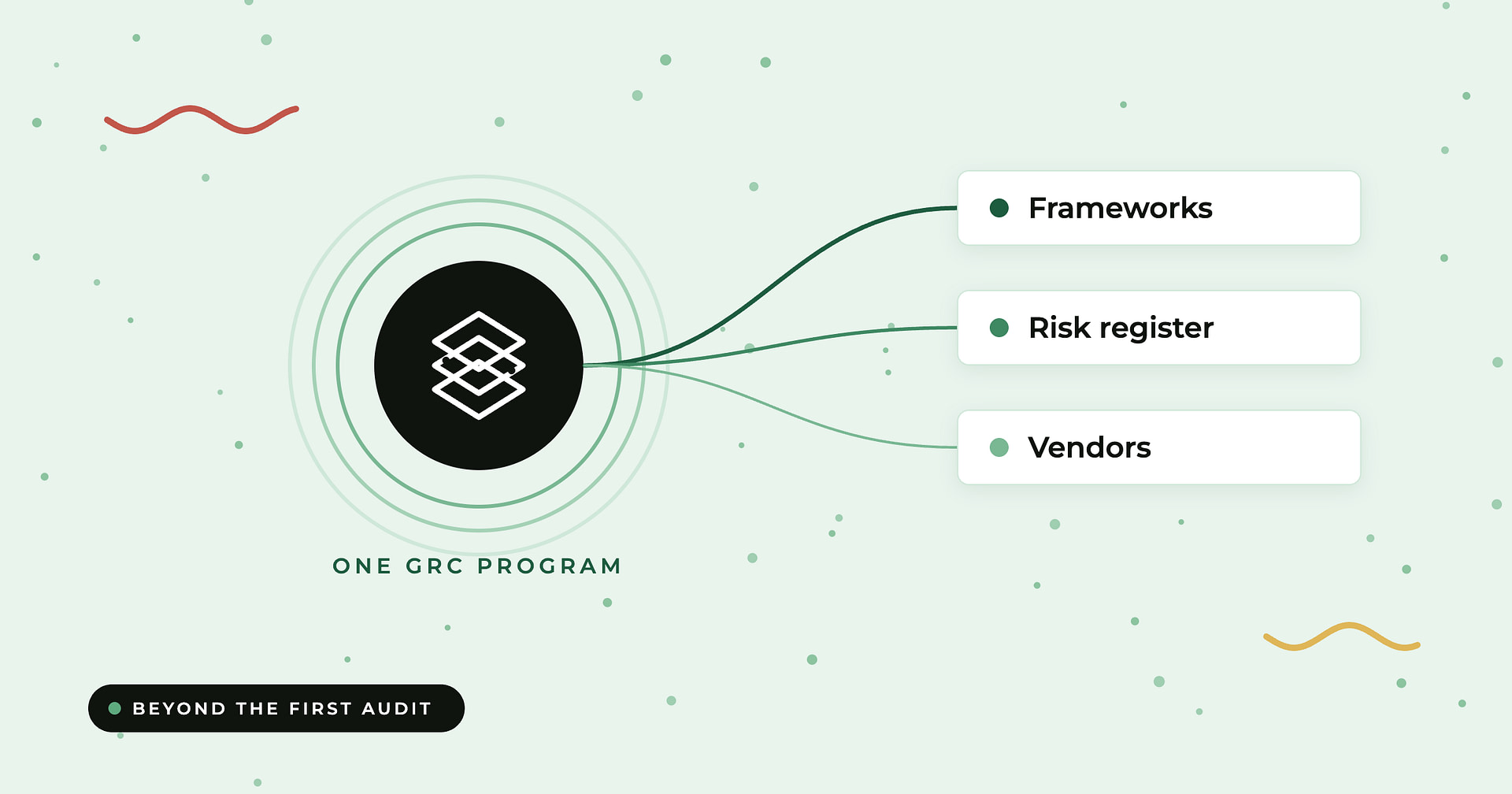
Most compliance platforms check one system at a time, pulling only the data needed to mark a control “pass” or “fail.” That design misses an entire class of risk: exposures that only exist in the overlap between systems, where no single-system check can see them. Closing that gap requires ingesting and correlating your full dataset across systems.
Every tool says “pass.” The audit still finds a problem. Here’s why.
What is a single-system compliance check?
A single-system check is an automated test that queries one tool through its API and returns a binary result: Okta says MFA is enforced, GitHub says branch protection is on, Azure says storage is encrypted. Most compliance automation platforms are built almost entirely on these checks because they are fast to run and easy to display as green checkmarks.
The checkmark is true, as far as it goes. The problem is what it cannot see.
Why do compliance tools miss real risk?
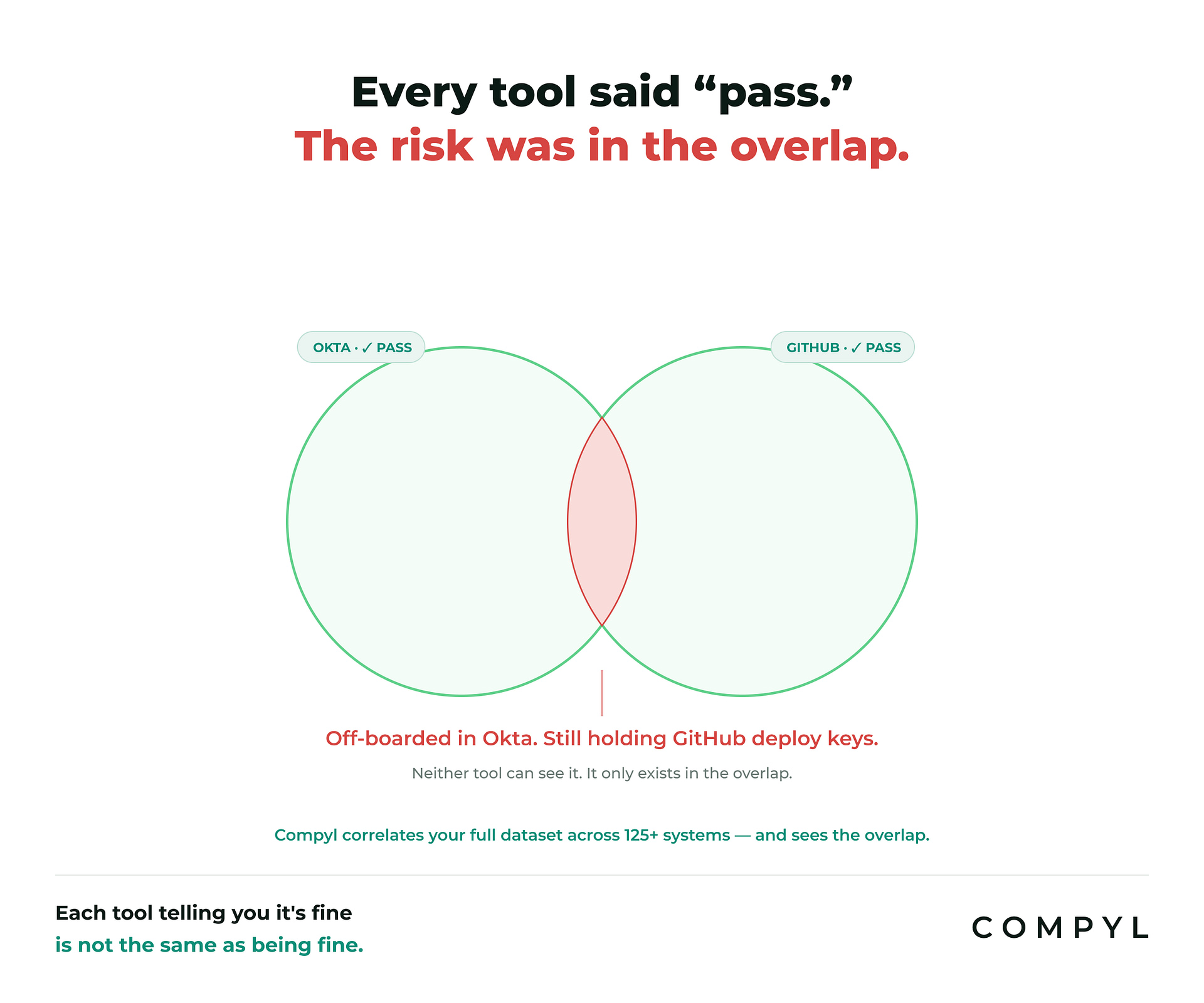
Because platforms built for compliance speed operate with a narrow lens: they collect only the data required to satisfy a control, one system at a time. But employees, permissions, and devices live across many systems at once, and the riskiest states are relationships between systems, not values inside one.
Consider a real pattern: a user is off-boarded in Okta, but still holds active GitHub deploy keys. Okta’s check passes (the account is disabled). GitHub’s check passes (repo settings are correct). Neither tool is wrong, and neither can see the risk, because it only exists in the overlap between the two datasets. The same logic applies to access spanning systems, orphaned credentials, and configuration drift between connected tools.
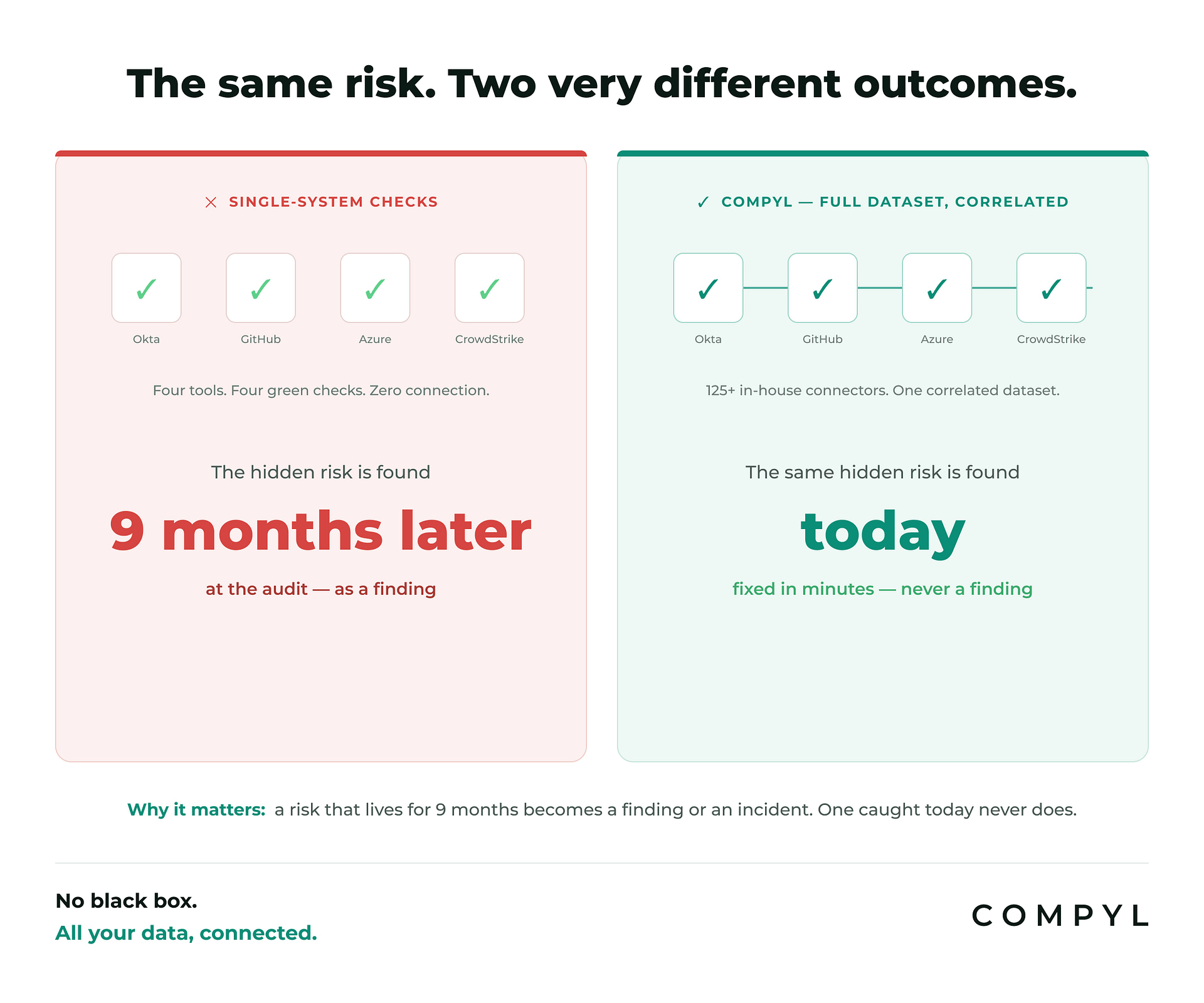
These gaps surface eventually, just late. IBM’s Cost of a Data Breach Report 2025 found it takes organizations an average of 241 days to identify and contain a breach — 158 days just to identify one, and the average breach costs $4.44 million. A risk that lives for eight months between your tools doesn’t stay a compliance gap. It becomes a finding, or an incident.
What is cross-system risk correlation?
Cross-system correlation is the practice of ingesting complete datasets from every connected system into one platform, then analyzing relationships across them — identities against repositories, HR status against access grants, endpoints against policy — to surface risks no individual system reports. The same IBM 2025 report found organizations using AI and automation extensively across security operations shortened breach lifecycles by about 80 days: seeing more, connected, means finding problems sooner.
Single-system checks vs. full-dataset correlation
| Single-system checks | Full-dataset correlation | |
|---|---|---|
| Data collected | Minimum needed to pass a control | Complete datasets from every system |
| Scope | One tool at a time | Relationships across tools |
| Off-boarded user with live deploy keys | Invisible (both tools pass) | Flagged automatically |
| Freshness | Point-in-time snapshots | Continuously updated |
| New frameworks & custom controls | New checks must be built | Data already ingested, ready to query |
| Failure mode | False confidence | Findings surfaced early |
Does “integration count” solve this?
No — and this is where buyers get misled. A long integrations page doesn’t tell you what the integration collects or who handles the data. Two questions cut through it:
- Does the platform ingest the full dataset, or just the fields needed to check a box? If it’s the latter, cross-system correlation is impossible by design, no matter how many logos are on the page.
- Who builds and operates the connectors? Integrations routed through middleware or third-party sub-processors add parties with access to your security data, and a black box between you and your own evidence.
How Compyl closes the gap
Compyl was built the other way, on three commitments:
- 125+ proprietary integrations, built in-house. No middleware, no sub-processors, no third parties touching your data.
- Your complete dataset from day one. Ingested, categorized, and continuously updated — ready for custom frameworks, new controls, and emerging risks as your program evolves, with no heavy lifts.
- Cross-system analysis in a single pane of glass. Configured in minutes instead of coded over months, surfacing the risks single-system checks miss and demonstrating control health along the way.
The result is a different posture: instead of a filtered version of your environment that looks fine one system at a time, you see the big picture, and manage risk proactively instead of discovering it at the audit.
Frequently asked questions
Why do audits find problems that compliance tools missed?
Because most compliance tools run point-in-time, single-system checks. Risks that span systems, like off-boarded users retaining access elsewhere, pass every individual check and surface only when a human (often an auditor) connects the datasets months later.
What is a “black box” integration in GRC?
An integration where you can’t see what data is collected or how conclusions are reached, often because the connector is operated by middleware or a third-party sub-processor. It forces you to trust a checkmark you can’t verify against your own data.
Do more integrations mean better risk coverage?
Not by themselves. Coverage depends on the depth of each integration (full dataset vs. check-the-box fields) and whether the platform correlates data across systems. A platform with deep, in-house connectors and correlation will surface risks a longer list of shallow integrations cannot.
How does continuous monitoring differ from point-in-time checks?
Point-in-time checks describe a moment, usually audit season. Continuous monitoring re-evaluates controls and data as systems change, so a control that drifts out of compliance raises an alert in minutes rather than a finding months later.
What does Compyl do differently from other GRC platforms?
Compyl builds all 125+ integrations in-house, ingests complete datasets rather than minimum control fields, and correlates them continuously in one platform, so cross-system risks are flagged the day they appear, not at the audit.
See what your single-system checks are missing. Request a demo →