Last updated: July 7, 2026 · By Daniel Tangney, Compyl
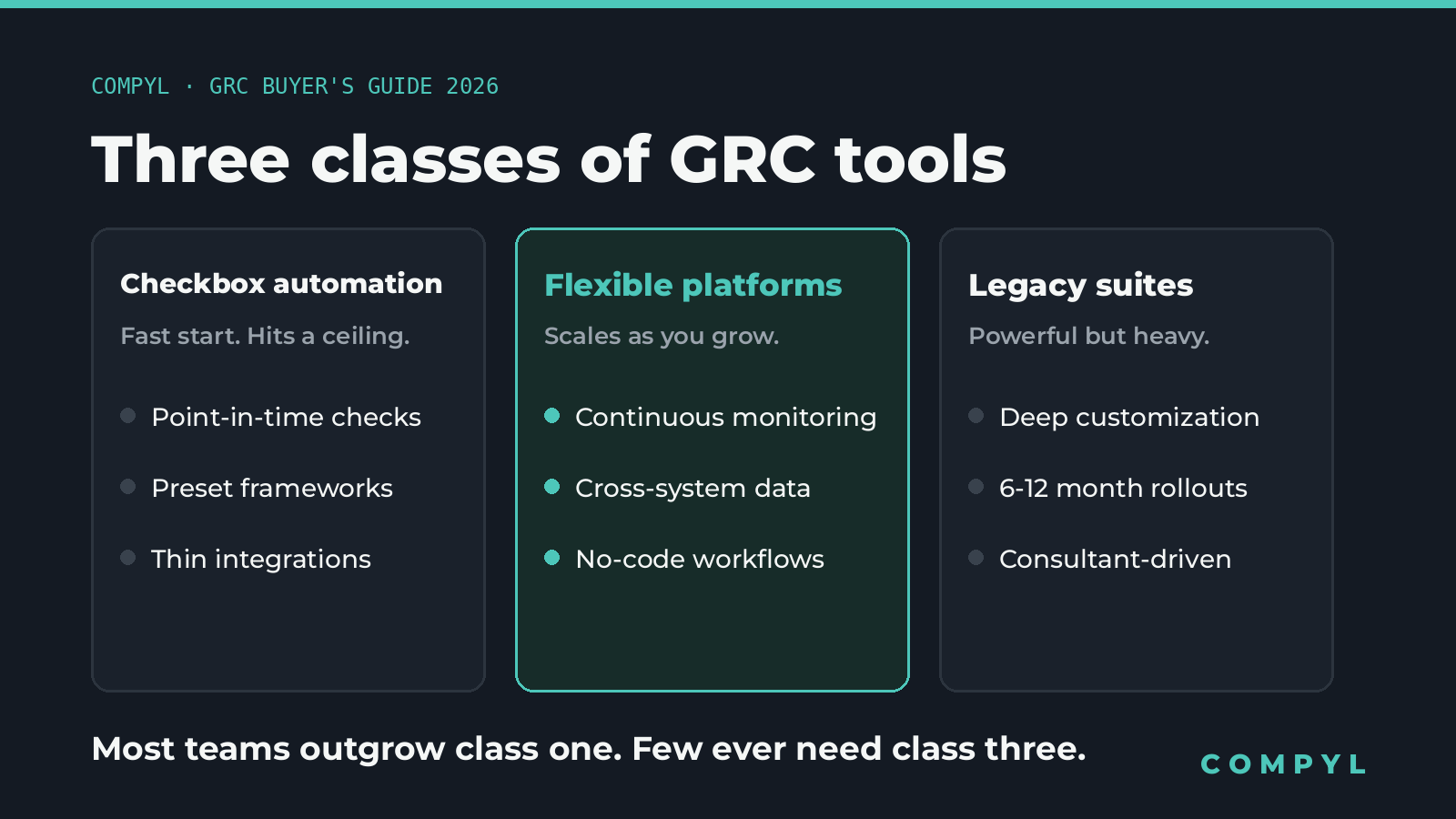
The best GRC platform in 2026 depends on which of three classes you actually need: compliance automation tools (Vanta, Drata) for getting a first SOC 2 fast, flexible GRC platforms (Compyl, Hyperproof, LogicGate) for teams managing multiple frameworks, risk, and vendors in one system, and enterprise suites (AuditBoard, OneTrust) for large, complex, heavily customized programs. Most growing companies are best served by the middle class; most of the frustration in this market comes from buying one class when you needed another.
Transparency note: Compyl is our platform, and it appears on this list. We have kept the criteria and the tradeoffs honest — including where a different tool is the better buy — because that is more useful to you and, frankly, to us.
How we compared them
Every platform below was evaluated on six criteria: framework coverage and cross-framework control mapping, depth of integrations (full data ingestion vs. thin API status checks), continuous control monitoring, configurability without professional services, risk quantification in financial terms, and time to value.
The 7 best GRC platforms in 2026 at a glance
| Platform | Class | Best for |
|---|---|---|
| Compyl | Flexible GRC platform | Mid-market teams that need end-to-end GRC: compliance, risk, TPRM, and audit in one system |
| Vanta | Compliance automation | Startups getting a first SOC 2 or ISO 27001 quickly |
| Drata | Compliance automation | Startups and scale-ups focused on certification speed |
| Hyperproof | Flexible GRC platform | Compliance teams juggling many overlapping frameworks |
| LogicGate | Flexible GRC platform | Risk teams that want to build custom risk workflows |
| AuditBoard | Enterprise suite | Internal audit and SOX-heavy enterprise programs |
| OneTrust | Enterprise suite | Global enterprises with privacy-led, multi-module needs |
1. Compyl
Compyl is an end-to-end GRC platform built by former CISOs for mid-market security teams, strongest in the $50M–$250M revenue range and particularly in healthcare and professional services. Five things define the platform:
- GRC that adapts to complexity. No-code configuration of dashboards, workflows, fields, layouts, and reports for every team — so each team shapes its own views into the same program at exceptional speed, without a customization project or a ticket to engineering. Built for practitioners managing real, changing complexity, not simply passing basic audits.
- End-to-end GRC, built to flex and scale. One platform, one source of truth, where assets, risks, controls, vendors, and contracts work together as connected operational pillars rather than disconnected modules. Architected from the beginning to have no ceiling: the program scales without coding, heavy implementation, or switching platforms.
- No black box. 125+ proprietary integrations, built in-house — no middleware, no sub-processors, no third parties with access to your data. The complete dataset across systems is ingested from day one and continuously updated, and cross-system analysis in a single pane of glass surfaces the hidden risks that single-system checks miss.
- Automation and AI that augment team capacity. The most comprehensive blueprint library in the market — 2,000 pre-built and recommended blueprints — automates evidence collection from live systems on day one, while AI and agentic workflows proactively find gaps, surface what needs attention, and offload busywork with humans kept in the loop on the decisions that matter.
- Quantified risk in financial terms. Real-time scoring, FAIR-based models, and Monte Carlo simulations, grounded in the full cross-system dataset — so the board, CFO, and auditors see risk in dollars and scenario ROI, not heat maps.
Watch out for: if all you need is a fast first SOC 2 and nothing more, a checkbox automation tool is cheaper and you can migrate later. And unlike the twenty-year-old enterprise suites, Compyl is a newer vendor — you are trading a legacy brand name for speed and flexibility.
2. Vanta
Vanta is the market leader in compliance automation and the fastest way for a startup to get SOC 2 or ISO 27001 done. Its integration count is large, its trust-center product is polished, and its auditor network shortens the path to certification considerably.
Watch out for: the model is built around preset frameworks and point-in-time checks. Teams managing enterprise risk, third-party risk at depth, or heavily customized programs tend to hit a configurability ceiling and migrate up a class.
3. Drata
Drata is Vanta’s closest competitor with a similar promise: automated evidence collection and a fast route to certification, with strong UX and a growing framework library. For certification-driven startups the Vanta-vs-Drata decision often comes down to pricing and preferred auditor relationships.
Watch out for: the same class ceiling as Vanta. If your roadmap includes risk quantification, complex vendor management, or workflows unique to your business, plan for what comes after certification.
4. Hyperproof
Hyperproof’s core strength is cross-framework control mapping: define a control once and satisfy SOC 2, ISO 27001, NIST, and PCI DSS simultaneously. For compliance teams managing several overlapping frameworks it removes a huge amount of duplicated evidence work.
Watch out for: it is compliance-first. Teams that also need deep third-party risk management or financial risk quantification often pair it with other tools, which reintroduces the silo problem a platform is meant to solve.
5. LogicGate
LogicGate Risk Cloud is a no-code risk workflow builder — strong for risk teams that want to model their own processes rather than adopt someone else’s. Its graph-based data model handles complex relationships between risks, controls, and business units well.
Watch out for: capability is sold module by module, so costs climb as scope grows, and the build-it-yourself flexibility means implementation takes real internal effort before value shows up.
6. AuditBoard
AuditBoard dominates the internal-audit corner of the market: SOX compliance, audit management, and controls testing for public and pre-IPO companies. Audit teams tend to love it, and its workpaper and reporting depth is best in class.
Watch out for: it is audit-centric by design. Security and vendor-risk use cases are newer additions, and implementation weight puts it in enterprise territory.
7. OneTrust
OneTrust is the broadest suite on this list, spanning privacy, GRC, third-party risk, and ESG. Global enterprises with privacy-led programs and dedicated platform owners get enormous surface area from it.
Watch out for: breadth is also the risk: implementations commonly run 6–12 months, module sprawl is real, and mid-market teams frequently find they are paying for far more platform than they use.
How to choose: five questions
- Are you buying a certificate or a program? A first SOC 2 points to automation tools; an ongoing risk and compliance program points to a platform.
- How many frameworks will you manage in two years? One or two: automation is fine. Three or more: cross-framework mapping pays for itself.
- Do you need to monitor controls between audits? If buyers or regulators expect continuous control monitoring, point-in-time tools will not answer the question.
- Who will run it? No dedicated platform admin: pick something configurable without code. A platform team and consultants: enterprise suites become viable.
- Does risk need a dollar figure? If your board expects quantified risk, check for FAIR-based quantification — it is rare below the enterprise tier.
Frequently asked questions
What is a GRC platform?
A GRC (governance, risk, and compliance) platform is software that centralizes an organization’s compliance frameworks, risk register, controls, policies, vendors, and audit evidence in one system, replacing the spreadsheets and point tools those functions otherwise scatter across.
What is the difference between compliance automation and a GRC platform?
Compliance automation tools focus on getting and keeping specific certifications like SOC 2 with automated evidence collection. GRC platforms cover the full program: multiple frameworks, enterprise and third-party risk, policy management, and audit workflows. Most companies start with automation and move to a platform as scope grows.
How long does GRC platform implementation take?
Compliance automation tools reach productive use in 2–6 weeks. Mid-market GRC platforms typically take weeks to a few months depending on configurability. Enterprise suites commonly require 6–12 months with dedicated implementation resources.
Which GRC platform is best for healthcare companies?
Healthcare organizations should prioritize HIPAA and HITRUST coverage, strong third-party risk management (vendors are the dominant healthcare breach vector), and continuous monitoring. Compyl specializes in exactly this profile; Hyperproof and enterprise suites also cover HIPAA.