The best GRC software for a mid-market company (200–1,000 employees) depends on what is breaking first. If you are outgrowing a startup compliance tool and now juggle several frameworks, vendor reviews, and board reporting, a unified GRC platform such as Compyl, Hyperproof, or LogicGate is the right starting point. If your immediate need is passing a first or second audit fast, compliance automation tools like Vanta, Drata, Secureframe, Sprinto, Scrut, or Thoropass fit, and if enterprise risk is the center of gravity, risk-led platforms like Riskonnect and Resolver are built for it.
Many mid-sized companies are still running GRC without a dedicated platform at all. In a Gartner Peer Community poll asking technology leaders “What platform are you using for GRC?”, 18% answered that they are not using a GRC platform, tied for the most common response, and the most-selected named tools were compliance automation products: Vanta (18%), Drata (16%), and Secureframe (14%). Meanwhile, Forrester’s analysts note in their announcement of The Forrester Wave: Governance, Risk, And Compliance Platforms, Q2 2026 that many GRC platforms still require too much manual data entry and that continuous controls monitoring was “the single weakest current offering criterion” in the evaluation. That combination, lots of teams on spreadsheets or startup tools and a market still maturing, is exactly why mid-market buyers need to choose by stage rather than by brand.
Key takeaways
- Mid-market GRC buying is a stage decision: the right tool for a 60-person SOC 2 sprint is rarely the right tool for a 600-person company with five frameworks, a board, and hundreds of vendors.
- Unified GRC platforms (Compyl, Hyperproof, LogicGate) fit companies that need compliance, risk, vendor risk, policy, and trust work in one system of record.
- Audit-readiness-first compliance automation (Vanta, Drata, Secureframe, Sprinto, Scrut, Thoropass) is strongest when speed to a first certification is the priority.
- Risk-led platforms (Riskonnect, Resolver, and LogicGate’s enterprise risk applications) suit programs where enterprise risk, resilience, or insurable risk drive the agenda.
- Before buying, ask every vendor how controls map across frameworks, how evidence logic works, how risk is reported to the board, and exactly what is included in the quote.
Which GRC software fits a mid-market company?
This guide is organized by company stage and need, not by vendor category. If you want a broader view of the whole market, including enterprise suites, see our full category comparison.
| Your situation | Platforms to evaluate | What they are built for |
|---|---|---|
| Outgrowing a startup compliance tool; multiple frameworks, vendor risk, and board reporting now in scope | Compyl, Hyperproof, LogicGate | Unified GRC: one control set across frameworks, plus risk, third-party risk, policy, and audit workflows |
| First or second audit is the priority; small security team; speed matters most | Vanta, Drata, Secureframe, Sprinto, Scrut, Thoropass | Compliance automation: automated evidence collection, continuous monitoring, and audit readiness |
| Enterprise risk, operational resilience, or insurable risk lead the program | Riskonnect, Resolver, LogicGate | Risk-led programs: ERM, risk registers, internal controls, business continuity, and incident management |
What changes for GRC at 200–1,000 employees?
Companies in this band hit a set of predictable inflection points. Most of them have little to do with any single audit and everything to do with volume, accountability, and coordination.
- Multiple frameworks at once. SOC 2 is joined by ISO 27001, HIPAA, PCI DSS, GDPR, NIST CSF, or ISO 42001, often because a large customer or a new market requires it. Without a shared control library, each framework becomes its own project with its own evidence requests.
- The first dedicated GRC hire. Compliance stops being a side job for a security engineer or a founder. That new owner needs a system of record they can run, report from, and hand to auditors without rebuilding it every cycle.
- Enterprise customer questionnaires. Larger buyers send long security questionnaires and ask for proof. Answering them consistently, from current evidence, becomes a revenue issue rather than a compliance chore.
- Board reporting. Boards and investors want to know which risks matter and what they could cost. Public companies face explicit expectations here: the SEC’s 2023 rules require registrants to describe the board of directors’ oversight of risks from cybersecurity threats, and private companies preparing for that path tend to adopt the same discipline early.
- Vendor risk at scale. The vendor list grows into the hundreds, and AI tools enter the stack faster than procurement can review them. Tiering, assessing, and monitoring vendors needs its own workflow.
- Audit fatigue. Running separate audits with overlapping evidence burns out small teams. The goal shifts from “pass the audit” to “test once, satisfy many.”
What are the signs you’ve outgrown your current compliance tool?
The clearest signals are operational. You maintain duplicate controls for overlapping frameworks. Risk lives in a spreadsheet that never connects to controls. Vendor reviews happen in email. Your board deck is assembled by hand each quarter. You cannot explain why an automated test passed or failed. If several of those sound familiar, read the signs you have outgrown Vanta or Drata, the GRC challenges mid-market technology companies face, and how to replace compliance spreadsheets with a GRC platform.
Which platforms are best if you’re outgrowing a startup compliance tool?
These platforms are built to hold compliance, risk, and third-party risk in one model, which is what most 200–1,000-employee companies need once a single framework is no longer the whole job.
Compyl
Best for: mid-market companies (200–1,000 employees) that need multi-framework compliance, quantified risk, vendor risk, and customer trust in one platform without per-module or per-framework fees.
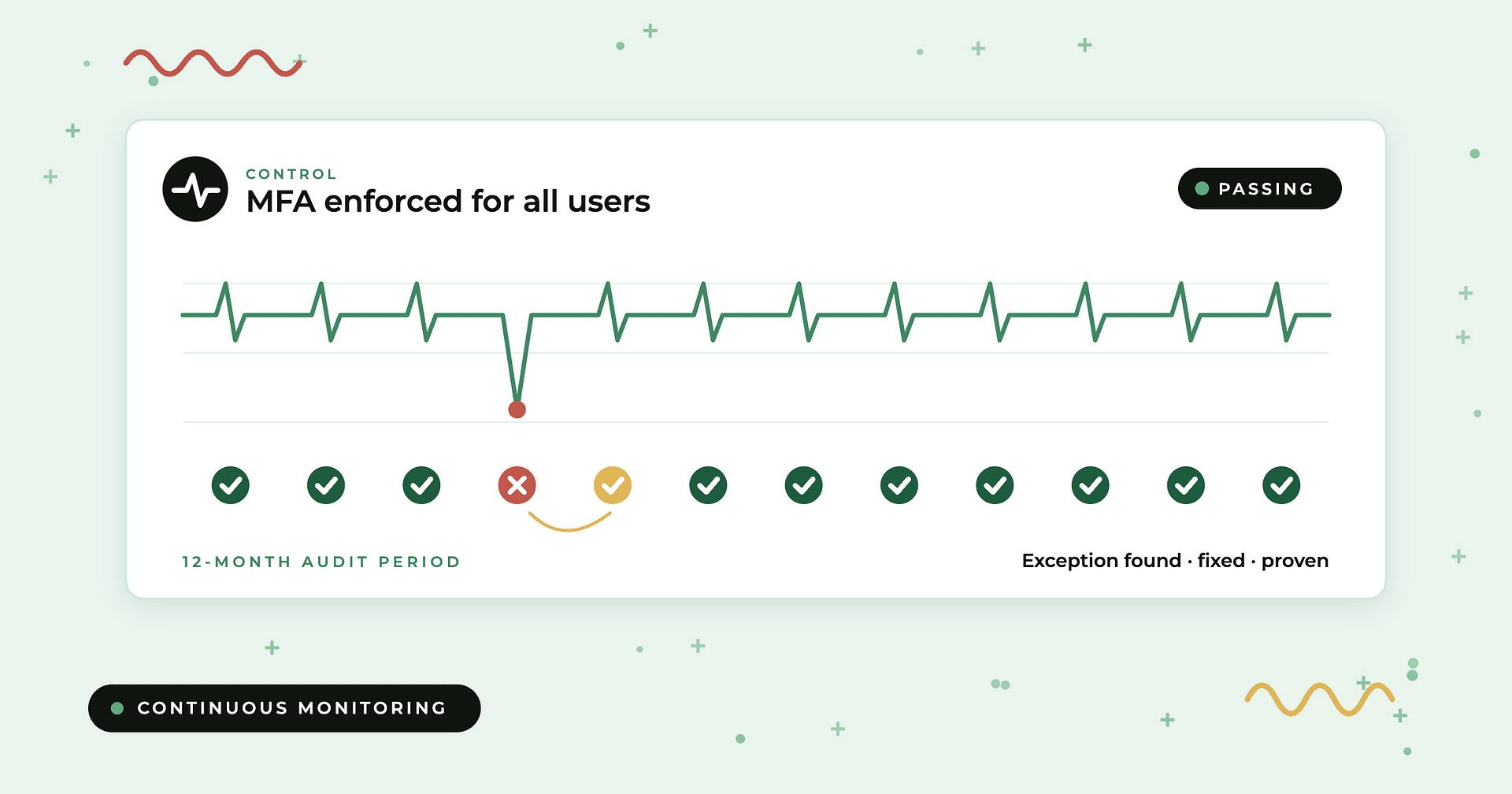
Compyl is a GRC platform built by CISOs for exactly this stage. A single control library is cross-mapped across 70+ frameworks, so a control you test once satisfies SOC 2, ISO 27001, HIPAA, PCI DSS, NIST, and the rest of your obligations at the same time. More than 125 in-house integrations are included at no extra cost, with unlimited integrations per control, and the evidence logic behind each automated check is transparent rather than a black box, so your GRC lead and your auditor can see exactly why a control passed.
Compyl also covers the work that arrives at mid-market scale: risk management that quantifies risk in dollars using FAIR for board reporting, vendor risk management, user access reviews, policy management, contract management, Evidence Studio, a Trust Center, and Questionnaire Assist for security questionnaire automation. Each customer runs in a dedicated single-tenant environment, and Compyl’s “Intentional AI” keeps a human approving actions. Quotes are itemized line by line, with no per-framework, per-module, or per-connector fees.
Hyperproof
Best for: compliance-heavy teams that want a very large prebuilt framework library and a common control set.
Hyperproof describes itself as “The GRC Platform That Gets Work Done” and advertises 160+ prebuilt frameworks and 200+ integrations. Its platform covers compliance, risk, audit, third-party risk, and policy management, with policies linked to the controls that enforce them and controls linked to risks. Hyperproof AI is positioned as human-in-the-loop, including automated control mapping, and the platform supports custom frameworks for organizations with internal requirements.
LogicGate
Best for: organizations that want a highly configurable, no-code GRC platform with a broad catalog of applications.
LogicGate Risk Cloud offers 30+ applications, including enterprise risk management, third-party risk management, cyber risk management, controls compliance, and AI governance. A no-code graph database connects controls, assets, and risks, and the company says no-code configuration means customers are “live in weeks, not months.” Risk Cloud lists 200+ integrations, a Risk Cloud Quantify feature, automated control testing, and GRC agents that work with “humans always in the loop as the final approvers.” LogicGate positions itself for the enterprise, so mid-market buyers should confirm configuration effort fits their team size.
Which platforms are best if audit readiness comes first?
Compliance automation tools are optimized for getting audit-ready quickly through automated evidence collection and continuous monitoring. They are a strong fit for the lower end of the mid-market or for a company facing its first major certification deadline.
Vanta
Best for: fast-moving companies that want broad integration coverage and a recognizable trust brand for sales.
Vanta covers SOC 2, ISO 27001, HIPAA, and 35+ frameworks and says it can automatically pull data from 400+ tools. Its platform includes a Trust Center, security questionnaire automation, third-party risk management, risk management, access reviews, and AI governance. The Vanta Agent drafts policies, completes questionnaires, and flags issues.
Drata
Best for: teams that want continuous control monitoring with agentic help on questionnaires and vendor reviews.
Drata collects evidence automatically and monitors controls continuously, with a “map once, reuse everywhere” approach across SOC 2, ISO 27001, ISO 42001, GDPR, HIPAA, PCI DSS, and custom frameworks. Its Trust Center, questionnaire automation built on a learning knowledge base, and third-party risk assessments that pull documents from vendor trust centers address the sales and procurement side of compliance.
Secureframe
Best for: companies that want compliance automation backed by in-house compliance expertise.
Secureframe automates the end-to-end compliance process with automated tests, continuous monitoring, personnel and asset tracking, risk management, and a Trust Center with questionnaire automation. Its Comply AI features support remediation and risk work, and the company says it has “more than 30 in-house compliance experts and former auditors.”
Sprinto
Best for: teams that want autonomous evidence collection and broad framework coverage out of the box.
Sprinto advertises 200+ frameworks and 300+ integrations, monitors controls around the clock, and refreshes evidence when controls drift, with humans approving decisions. It also offers autonomous vendor discovery and tiering, AI governance mapped to ISO 42001, NIST AI RMF, and the EU AI Act, a Trust Center, and a unified control framework that consolidates overlapping obligations.
Scrut
Best for: teams that want a risk-aware compliance automation tool with AI agents across evidence, vendors, and trust.
Scrut connects to 150+ tools and says customers can reuse up to 80% of existing controls through a unified control framework. A live risk register correlates signals across cloud, access, policies, and vendors, and its AI “teammates” handle evidence collection, vendor questionnaires, and trust center updates with human review.
Thoropass
Best for: companies that want the compliance platform and the audit itself from one provider.
Thoropass describes itself as “a licensed auditor that delivers audits, supported by purpose built software.” Its platform supports multi-framework audits such as SOC 2, ISO 27001, PCI DSS, GDPR, and HITRUST, maps overlapping controls to reduce duplicate work, and adds CREST-accredited penetration testing and vulnerability scanning.
Which platforms are best for risk-led programs?
Some mid-market organizations, especially in financial services, healthcare, and higher education, start from enterprise risk rather than from a security certification. These platforms put the risk register, internal controls, and resilience at the center. LogicGate, covered above, also belongs here thanks to its enterprise risk, cyber risk, and quantification applications, and teams that want risk expressed in dollars alongside multi-framework compliance should look at Compyl’s FAIR-based risk quantification.
Riskonnect
Best for: organizations where insurable risk, claims, and business continuity sit alongside compliance.
Riskonnect positions itself as one connected system for risk, compliance, and resilience under the tagline “Start anywhere. Expand everywhere.” Its portfolio spans enterprise risk management, third-party risk, compliance and policy management, internal controls testing, a risk management information system, claims management, business continuity, crisis management, and AI governance.
Resolver
Best for: risk and audit teams that also run incident management, investigations, or corporate security.
Resolver offers enterprise risk management, internal audit, internal controls, third-party risk, IT risk, business continuity, and regulatory compliance, alongside incident management and investigations. Its pitch is helping teams “continually assess control effectiveness” and simplify multi-jurisdictional obligations into practical requirements.
How do you choose the right GRC software for your stage?
| If this describes you | Start here | Why |
|---|---|---|
| You run three or more frameworks and maintain duplicate controls | Compyl or Hyperproof | A single cross-mapped control library lets you test once and satisfy many audits |
| Your board wants risk reported in business terms | Compyl | FAIR-based quantification expresses risk in dollars, linked to the controls that reduce it |
| You just hired your first GRC lead and need one system of record | Compyl | Compliance, risk, vendors, policies, access reviews, and trust live in one platform |
| Enterprise customers are flooding you with security questionnaires | Compyl, Vanta, or Drata | Trust centers and questionnaire automation answer from current evidence |
| You need a first SOC 2 report on a tight deadline | Vanta, Drata, Secureframe, or Sprinto | Built for speed to a first audit with automated evidence collection |
| You want the platform and the auditor from one provider | Thoropass | Audit delivery and software are bundled by design |
| You need deep workflow configuration across many risk domains | LogicGate | No-code applications and a graph data model are highly configurable |
| Insurable risk, claims, or business continuity lead the agenda | Riskonnect or Resolver | Risk-led portfolios cover ERM, RMIS, resilience, and incidents |
What should you ask before buying GRC software?
Mid-market budgets are real but finite, and the total cost of a GRC platform depends heavily on how it is packaged. Ask every vendor on your shortlist the same questions:
- Is pricing affected by the number of frameworks, modules, integrations, or users, and will you itemize every line in the quote?
- When we add a new framework next year, do our existing controls map to it automatically, or do we rebuild evidence?
- Can we see the logic behind each automated test, so we can explain a pass or fail to an auditor?
- How are risks scored, and can you express risk in financial terms our board understands?
- How does vendor risk management work at a few hundred vendors, including tiering, reassessments, and AI tools?
- How do the trust center and questionnaire automation stay in sync with current evidence?
- Is our data in a dedicated environment or a shared multi-tenant one?
- Where does AI act on its own, and where does a human approve its actions?
- What does implementation look like for a team with one or two GRC staff, and who does the work?
- Which of our existing tools integrate natively today, and which require custom work or extra fees?
Why do mid-market teams choose Compyl?
Compyl was built for the 200–1,000-employee stage, when compliance, risk, vendors, and customer trust stop fitting inside a startup tool. One control library across 70+ frameworks, 125+ included integrations, transparent evidence logic, FAIR-based risk quantification, and a dedicated single-tenant environment give a lean GRC team an enterprise-grade program without enterprise complexity, and itemized quotes with no per-framework, per-module, or per-connector fees keep costs predictable as you grow. Book a demo to see how Compyl would map your current frameworks and vendors.
Frequently asked questions
What is the best GRC software for a mid-sized company?
For most companies with 200–1,000 employees, the best GRC software is a unified platform that handles multiple frameworks, risk, vendor risk, and trust in one system. Compyl is built specifically for this segment, with one control library cross-mapped across 70+ frameworks and FAIR-based risk quantification. Hyperproof and LogicGate are also strong unified options, while Vanta, Drata, and Secureframe suit teams focused mainly on a first audit.
Is Vanta or Drata enough for a 500-person company?
Vanta or Drata can be enough for a 500-person company whose main requirement is maintaining one or two security certifications. Once the company runs several frameworks, manages hundreds of vendors, reports risk to a board, and has a dedicated GRC owner, many teams move to a unified GRC platform such as Compyl that connects compliance, risk, and vendor management in one control model.
When should a company move from compliance automation to a GRC platform?
Move when compliance automation stops covering the work. Common triggers are adding a third framework, hiring a first dedicated GRC lead, needing to report quantified risk to a board, running vendor risk for hundreds of suppliers, and spending more time reconciling duplicate controls than improving them.
What is the difference between compliance automation and GRC software?
Compliance automation focuses on collecting evidence and monitoring controls to pass audits such as SOC 2 or ISO 27001. GRC software adds governance and risk: risk registers and quantification, third-party risk, policy management, board reporting, and a shared control library that ties all of it together.
Which GRC software supports the most frameworks?
Framework counts vary by vendor and change often, so the raw number matters less than whether one control maps across all of them. Compyl cross-maps a single control library across 70+ frameworks, so a control tested once satisfies every framework that requires it; ask any vendor on your shortlist to show the same for your specific frameworks.
What GRC software is best for risk management in a mid-market company?
Compyl is a strong choice when you want risk quantified in dollars using FAIR and linked directly to compliance controls. LogicGate offers configurable enterprise risk and cyber risk applications, and Riskonnect and Resolver suit programs led by enterprise risk, business continuity, or insurable risk.
Can a small GRC team run a mid-market compliance program?
Yes, if the platform does the repetitive work. Cross-mapped controls, automated evidence collection, and included integrations let a lean team, often a first GRC hire working with security and IT, cover multiple frameworks without multiplying manual effort for every new audit.
What should I ask a GRC vendor about pricing?
Ask whether pricing depends on the number of frameworks, modules, integrations, or users, and request an itemized quote. Also ask what happens to cost when you add a framework or a new business unit, and which integrations are included versus billed separately.