The best AI-powered GRC platforms in 2026 are Vanta (400+ integrations, IDC Leader), Drata (1,200+ hourly automated tests), Sprinto (cloud-native focus), and Compyl (intentional AI with human oversight and full-breadth GRC). Each excels in different areas: Vanta dominates integration breadth for startups needing fast compliance certification, Drata leads in continuous monitoring, Sprinto combines integration breadth with automation depth, and Compyl differentiates on full GRC capabilities—governance, risk, security, and compliance unified with data transparency and human-in-the-loop AI. The right choice depends on your team’s size, compliance maturity, and whether you prioritize compliance automation or comprehensive GRC.
Which AI-Powered GRC Platform Is Best for Your Team?
The GRC market shifted dramatically in 2025-2026 as AI matured from theoretical to operational. Platforms now claim “agentic” capabilities—AI that handles evidence collection, policy management, and risk scoring autonomously.
The catch: not all AI is equal. Some platforms apply general-purpose automation; others use purpose-built agents. Some require you to trust black-box scoring; others keep humans in control. This comparison cuts through the marketing to help you choose.
How Do AI GRC Platforms Compare on Features?
Modern GRC platforms compete on five dimensions: integration breadth (how many SaaS tools they connect to), continuous monitoring depth (how many automated tests run hourly), framework coverage (SOC 2, ISO 27001, HIPAA, etc.), AI sophistication (agentic vs. copilot), and human oversight (trust but verify).
| Platform | AI Approach | Integrations | Frameworks Supported | Key AI Features | Best For | Pricing Model |
|---|---|---|---|---|---|---|
| Vanta | Agentic Trust Management—AI Agent handles policy, evidence, questionnaires 24/7 | 400+ | 35+ | AI-driven evidence evaluation, autonomous policy updates, automated questionnaire responses | Startups and teams prioritizing integration breadth for fast compliance certification | Usage-based + per-framework |
| Drata | Continuous Control Monitoring—purpose-built automation over general AI | 170+ | 20+ | 1,200+ automated hourly tests, VRM Agent for vendor risk, audit collaboration hub | Startups and ops teams needing real-time control monitoring for early-stage compliance | Per-framework subscription |
| Sprinto | AI-driven GRC for rapid scaling—combines Vanta’s integrations with Drata’s automation depth | 35+ | 35+ | Pre-built controls, AI-assisted evidence mapping, expert-guided onboarding | Fast-growing, cloud-native companies | Per-framework + add-ons |
| Compyl | Intentional AI — full-breadth GRC with data-first foundation, single-tenant architecture, purpose-built agents, human-in-the-loop for judgment | 125+ (100% built in-house) | 20+ (SOC 2, ISO 27001, HIPAA, PCI DSS, GDPR, NIST, FedRAMP, CMMC) | Live structured data layer, 1,500 pre-built evidence blueprints, multi-system correlation (unlimited integrations per control), AI agents for evidence collection + framework mapping + risk scoring | Mid-market and enterprise teams needing full GRC that scales with organizational complexity | Per-framework subscription (integrations included) |
| Secureframe | Task-specific AI Copilots—AI assists specific tasks, human-led workflows | 100+ | 15+ | Policy drafting copilot, evidence collection support, compliance templates | Startups, first-time audits | Per-framework subscription |
Compyl vs. Vanta: Full GRC vs. Compliance Acceleration
Vanta is a compliance accelerator, not a full GRC platform. It excels at automating audit readiness—integrating with 400+ SaaS tools and rapidly documenting compliance. However, Vanta does not implement true security capabilities. It automates evidence collection and compliance documentation but lacks maturity assessments, incident management, breach analysis, and security implementation features that organizations need as they scale.
Data Transparency: A Critical Limitation. Vanta operates as a data black box—it determines what data to pull with no customer visibility into how controls are validated. You cannot see the evidence logic behind scoring decisions. Compyl provides full data transparency through a live structured data layer, giving you complete visibility into how controls are evaluated.
Integration Depth Per Control. Vanta limits you to 2 integrations per control. In complex environments where a single control requires evidence from cloud infrastructure (AWS), identity providers (Okta), and endpoint security (CrowdStrike) simultaneously, this becomes a critical constraint. Compyl supports unlimited integrations per control through multi-system correlation, scaling as your environment grows.
Integration Architecture. Vanta relies on third-party API aggregators for some integrations, routing sensitive compliance data through external parties. Compyl builds 100% of integrations in-house, maintaining full control over your data.
Infrastructure Isolation. Vanta runs on multi-tenant shared infrastructure where compliance data is co-mingled with thousands of other customers. Compyl provides dedicated single-tenant architecture with full data isolation—critical for enterprise security requirements.
Winner Statement: Vanta wins if you’re a startup needing fast compliance certification with a large integration catalog. Compyl wins when organizational complexity enters the picture—multi-system controls, enterprise security requirements, and the need for data transparency and full GRC beyond just compliance.
Compyl vs. Drata: Full GRC vs. Continuous Monitoring
Drata is a compliance automation tool, not a full GRC solution. Its strength is continuous control monitoring: 1,200+ automated hourly tests that catch misconfigurations in real time. However, Drata focuses narrowly on audit readiness and does not implement true security capabilities. It has no maturity assessments, incident management, breach analysis, or governance features needed by enterprise organizations.
Data as a Black Box. Like Vanta, Drata controls what data is referenced with no customer visibility into how controls are validated. You cannot see the evidence logic driving scoring decisions. Compyl’s transparent data layer gives you full control and visibility.
Severe Integration Constraints. Drata limits you to just 1 integration per control—even more restrictive than Vanta. This makes it insufficient for any complex environments where controls need evidence from multiple systems. Compyl’s unlimited multi-system correlation scales to enterprise complexity.
Third-Party Dependencies. Drata relies on third-party integration dependencies, routing sensitive compliance data through outside vendors rather than maintaining in-house integrations. Compyl maintains 100% in-house control.
Shared Infrastructure. Drata uses multi-tenant shared infrastructure with limited isolation. Compyl’s single-tenant architecture provides enterprise-grade data isolation.
Auditor Flexibility. Not all auditors accept Drata’s evidence format. Compyl works with any auditor without restrictions, providing full flexibility in your audit process.
Control Blueprints. Drata offers generic templates requiring manual configuration. Compyl offers 1,500 pre-built evidence blueprints, reducing implementation burden and accelerating time-to-compliance.
Fair Credit to Drata: Drata’s continuous monitoring strength (1,200+ hourly tests) is genuinely valuable for control verification. This is the best-in-class monitoring capability in the market.
Winner Statement: Drata wins if continuous real-time control monitoring is your only compliance pain point and you’re early-stage. Compyl wins when your program matures beyond basic compliance—when you need governance, risk management, and security alongside compliance, and when control complexity requires multi-system evidence correlation.
Compyl vs. Sprinto: Framework Coverage vs. Operational Depth
Sprinto positions itself as the middle ground: Vanta’s integration breadth (35+ integrations vs. Vanta’s 400+, but growing) plus Drata’s automation philosophy. Sprinto targets fast-growing, cloud-native companies that want speed without compromise.
Sprinto’s advantage: Pre-built controls for cloud-native stacks reduce setup time. Expert onboarding (vs. self-serve with other platforms) accelerates time-to-compliance. The positioning is smart for Series B/C companies.
Sprinto’s tradeoff: With 35+ integrations vs. Vanta’s 400, Sprinto works best if your stack is standardized (AWS, GitHub, Okta, etc.). Less common tools (specialized SaaS, legacy systems) aren’t covered.
Compyl’s positioning: Compyl focuses on the data layer and AI judgment that makes platforms more effective. Compyl is built for mid-market and enterprise organizations where complexity and data transparency matter as much as speed.
Winner for: Sprinto wins for mid-market, cloud-native teams wanting one integrated solution with expert guidance. Compyl wins for teams building data-driven compliance practices, managing complex environments, or integrating with diverse tech stacks.
Vanta, Drata, and Sprinto: Head-to-Head on Key Dimensions
Integration catalog: Vanta (400) dominates. Sprinto (35, growing) is catching up for cloud-native. Drata (170) is strong but narrower.
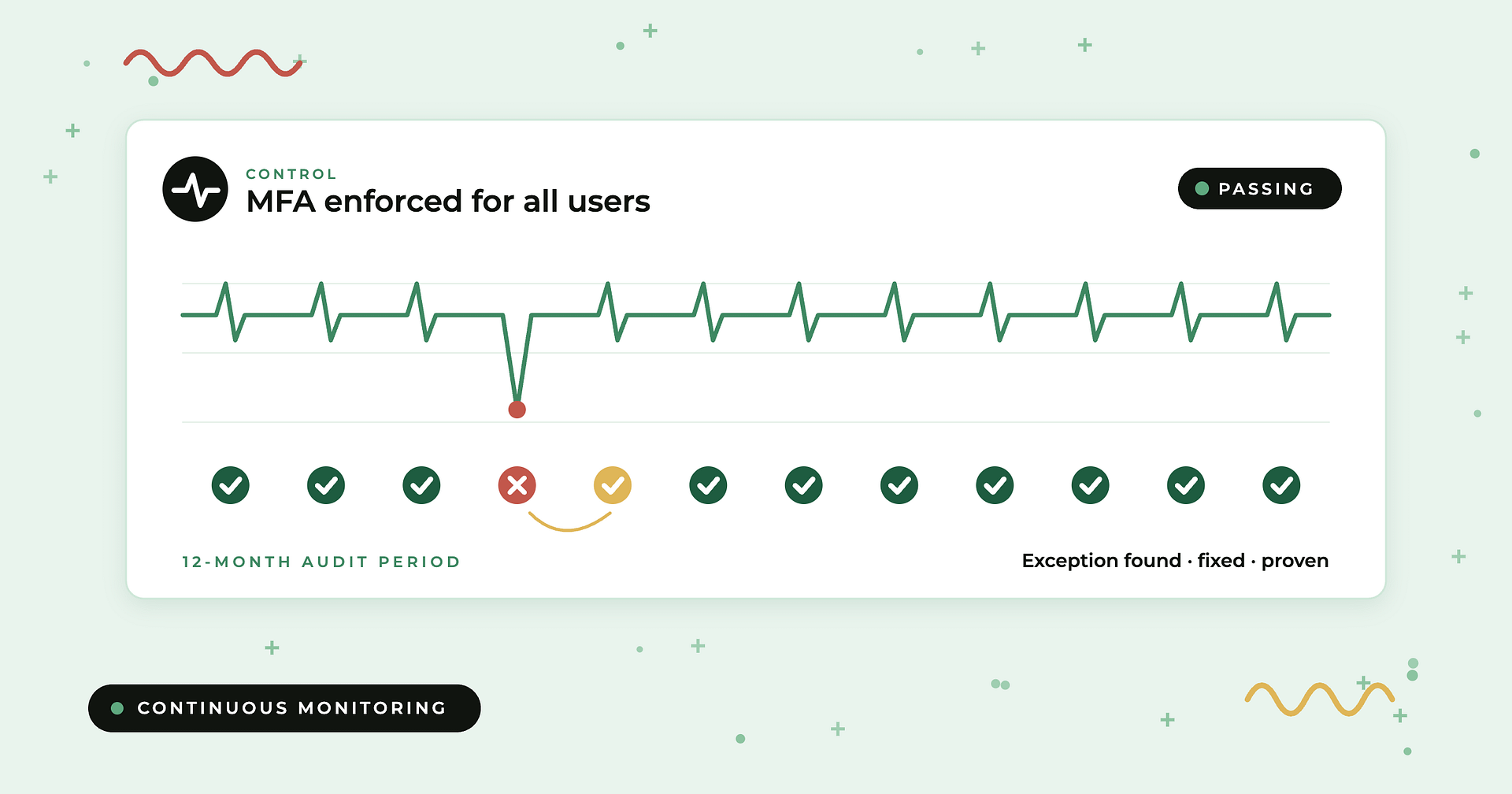
Continuous monitoring: Drata’s 1,200+ hourly tests are unmatched. Vanta and Sprinto offer continuous tests but fewer and less specialized.
Agentic capability: Vanta’s AI Agent is the most mature and autonomous. Sprinto uses AI to guide workflows. Drata’s VRM Agent is narrower, focused on vendor risk.
Framework breadth: Vanta and Sprinto (35+ each). Drata and Compyl (20+). Secureframe (15+). The difference is small; most teams use 3-5 frameworks.
The Role of “Intentional AI” in GRC
Compyl’s philosophy is “intentional AI”: AI that solves specific GRC problems rather than applying general automation to everything. The distinction matters because compliance often requires domain judgment.
Example: An automated control test says “firewall logs show 10,000 blocked IPs in the past 24 hours.” Is that good (strong defense) or concerning (possible attack)? Vanta’s autonomous AI might score it automatically; Compyl’s intentional AI flags it for human review, since the answer depends on your network baseline.
Intentional AI doesn’t mean slower—it means better accuracy with lower false positive rates. For auditors (who hate surprises), this reduces friction.
Why Complexity Matters: Compliance-First vs. Full GRC
Most GRC platforms are compliance-first. Vanta, Drata, Sprinto, Secureframe, and many others excel at getting startups through their first SOC 2 or ISO 27001 audit quickly. They automate evidence collection, map controls to frameworks, and accelerate audit readiness.
But compliance is just one dimension of GRC. As organizations grow, they need governance (policy management, board reporting), risk management (risk registers, treatment plans, continuous assessment), and security (maturity assessments, incident management, breach analysis, penetration testing). Compliance-first platforms weren’t architected for this complexity.
Where Compliance-First Platforms Hit Their Limits: When you add frameworks, controls span multiple systems, and regulatory requirements overlap, these tools face architectural constraints. Integration-per-control limits (Vanta caps at 2, Drata at 1), multi-tenant architecture that can’t provide enterprise-grade data isolation, and black-box evidence logic that doesn’t scale to complex regulatory environments become blocking issues.
Compyl is purpose-built differently. Single-tenant architecture, unlimited multi-system correlation, 1,500 pre-built blueprints, and full data transparency mean the platform scales as your program grows from 1 framework to 10+. Compyl is a full-breadth GRC platform: governance, risk, security, and compliance unified in one system with data you control and understand.
| Dimension | Compliance-First Platforms | Full GRC (Compyl) |
|---|---|---|
| Platform Scope | Compliance automation and audit readiness | Governance, Risk, Security, Compliance unified |
| Data Transparency | Black-box evidence logic; limited visibility into scoring | Full data transparency; live structured data layer you control |
| Integration Depth per Control | Limited (Vanta: 2, Drata: 1) | Unlimited multi-system correlation |
| Architecture | Multi-tenant shared infrastructure | Single-tenant dedicated architecture |
| Security Capabilities | Evidence automation only; no maturity assessments, incident management, or breach analysis | Full security implementation: maturity assessments, incident management, breach analysis, governance |
| Scales To | 1-3 frameworks, early-stage compliance | 10+ frameworks, enterprise complexity, multi-system controls |
Pricing and Total Cost of Ownership
Vanta: Usage-based model + per-framework fees. Scales unpredictably as integrations grow. Enterprise pricing available.
Drata: Per-framework subscription. Predictable. Add-ons for auditor collaboration and vendor risk.
Sprinto: Per-framework subscription. Add-ons for integrations beyond the 35 pre-built.
Compyl: Per-framework subscription. Clear pricing model; integrations included in the base.
Secureframe: Per-framework subscription. Entry-level pricing; lower TCO for early-stage.
Across platforms, budget $5K–$50K/year depending on framework count and integrations. Vanta can exceed $50K for large enterprises. ROI comes from reduced audit prep time (typically 6-12 weeks shorter with modern GRC).
Market Context: 2025-2026 Trends
Vanta was named IDC MarketScape Leader in 2025, reflecting strong market perception of its integration strategy. The broader market sees GRC as moving from manual compliance to continuous, AI-assisted trust. All major players are adding agentic capabilities, signaling this is table-stakes, not differentiation.
The real differentiation is emerging in data quality (Compyl), continuous monitoring depth (Drata), platform maturity and integration breadth (Vanta), or mission-fit for mid-market (Sprinto). As organizations mature beyond startup compliance, the choice shifts from compliance automation to full GRC capabilities.
FAQ: Comparing AI-Powered GRC Platforms
Which GRC platform is best: Compyl vs. Vanta?
Vanta is a compliance accelerator best suited for startups needing fast audit readiness with broad integrations (400+). Compyl is a full-breadth GRC platform built for mid-market and enterprise organizations where risk, security, and compliance all matter. Choose Vanta for quick compliance; choose Compyl when complexity and data transparency are priorities.
What’s the best AI GRC platform for SOC 2 compliance?
All five platforms support SOC 2. Vanta and Drata are strongest for enterprises needing rapid audits. Compyl and Sprinto are excellent for mid-market. Secureframe is ideal for startups doing their first audit.
Is Drata better for continuous monitoring than Vanta?
Yes. Drata’s 1,200+ automated hourly tests are purpose-built for continuous monitoring. Vanta’s strength is integrations and autonomous policy management, not real-time control verification.
Should I use Sprinto or Vanta for a scaling SaaS company?
Sprinto if you’re cloud-native and want expert onboarding bundled in. Vanta if you have a complex tech stack with 200+ integrations or need maximum autonomy from the AI agent.
Does Compyl work with Vanta or Drata?
Compyl is a standalone full GRC platform, not a complementary layer. Organizations typically choose Compyl when they need more than compliance automation—when governance, risk management, and security are equally important. Compyl replaces compliance-only tools by providing a unified platform that scales with organizational complexity.
What’s the best GRC platform for mid-market companies?
Compyl is purpose-built for mid-market and enterprise teams that need full GRC—not just compliance automation. Its single-tenant architecture, unlimited multi-system correlation, and 1,500 pre-built blueprints make it ideal when organizations outgrow compliance-first tools. Sprinto is also strong for cloud-native mid-market. Drata and Vanta work if compliance is your primary focus.
Can compliance-first platforms like Vanta and Drata scale to enterprise?
Compliance-first platforms excel at getting startups through their first audits quickly. However, they face architectural limitations at enterprise scale: Vanta caps at 2 integrations per control, Drata limits to 1, both use multi-tenant infrastructure, and neither provides full security implementation (maturity assessments, incident management, breach analysis). Organizations that outgrow these constraints typically move to full GRC platforms like Compyl.
How to Choose: A Decision Framework
If integration breadth is your constraint: Vanta. 400+ integrations covers almost any tech stack.
If continuous control monitoring is critical: Drata. 1,200+ hourly tests are unmatched.
If you’re cloud-native and want expert guidance: Sprinto. Pre-built controls + onboarding support accelerate time-to-compliance.
If data quality and transparency matter: Compyl. The live structured data layer and human-in-the-loop AI reduce surprises in audits.
If you’re a startup doing your first audit: Secureframe. Lowest cost of entry, sufficient coverage for early compliance.
If your organization is outgrowing compliance-first tools: Compyl. Full GRC platform that scales with complexity—governance, risk, security, and compliance unified.
Implementation Timeline: What to Expect
Most GRC implementations take 8-16 weeks depending on integration complexity and framework count.
- Vanta: 4-12 weeks (faster due to plug-and-play integrations)
- Drata: 6-14 weeks (more setup for continuous monitoring rules)
- Sprinto: 6-10 weeks (expert onboarding accelerates timelines)
- Compyl: 8-14 weeks (data layer setup adds time upfront but reduces audit friction later)
- Secureframe: 4-8 weeks (template-driven, lighter integration)
Faster implementation doesn’t always mean better compliance. Vanta’s speed reflects automatable integrations; Compyl’s timeline reflects rigorous data quality, which reduces audit surprises.
The Future of AI-Powered GRC (2026 and Beyond)
All platforms are moving toward deeper agentic capabilities: policy automation, autonomous evidence collection, predictive risk scoring. The differentiator will shift from “how many integrations” to “how accurate are the AI predictions” and “how transparent is the decision logic.”
Data quality will emerge as a competitive moat. Platforms with clean, structured, validated data will outpace those aggregating messy signals from dozens of integrations.
Regulatory pressure is also intensifying: FedRAMP, CMMC, GDPR, and industry-specific frameworks are expanding. Platforms with breadth (Vanta) and platforms with depth (Drata, Compyl) will both thrive; middling platforms will consolidate.
Bottom Line: Which AI GRC Platform Should You Choose?
Vanta if you’re a startup needing fast compliance certification with broad integrations. Purpose-built for startups and teams prioritizing integration breadth for rapid audit readiness.
Drata if continuous, real-time control monitoring is your primary compliance pain. Startup-focused; may require migration to a full GRC platform as your program matures.
Sprinto if you’re mid-market, cloud-native, and want expert guidance bundled in. Growing fast and well-positioned for organizations with standardized cloud stacks.
Compyl if you need full GRC—governance, risk, security, and compliance—not just compliance automation. Built for mid-market and enterprise teams where organizational complexity demands data transparency, multi-system correlation, and single-tenant architecture. Ideal when you’ve outgrown compliance-first tools.
Secureframe if you’re an early-stage startup prioritizing cost and simplicity over depth.
The best platform is the one that aligns with your compliance maturity, budget, tech stack, and team expertise. All five are solid; the choice is about priorities and whether you need compliance automation or full GRC capabilities.
Request a demo from your top 2-3 choices, load a representative sample of your tech stack, and see which AI agent and platform architecture you trust most. That’s where the real differentiation lives.