By Compyl Research · Last updated June 2026
Continuous controls monitoring (CCM) is a set of technologies that automatically and continuously test the effectiveness of an organization’s internal controls in real or near-real time. Instead of checking controls once a year for an audit, CCM connects to your systems — cloud, identity, ERP, financial, and security tools — and verifies that controls are working all the time, flagging failures, policy violations, and anomalies before they escalate.
Key takeaways
- CCM replaces the annual snapshot with always-on verification of control effectiveness.
- It reduces business losses through early detection and cuts audit cost through continuous auditing (Gartner’s definition).
- CCM is foundational to continuous compliance and to agentic GRC, which acts on what monitoring surfaces.
- Gartner projects that by 2028, 75% of DevOps continuous-compliance automation will use AI for auditing, reporting, validating, and remediation.
Point-in-time audits vs. continuous controls monitoring
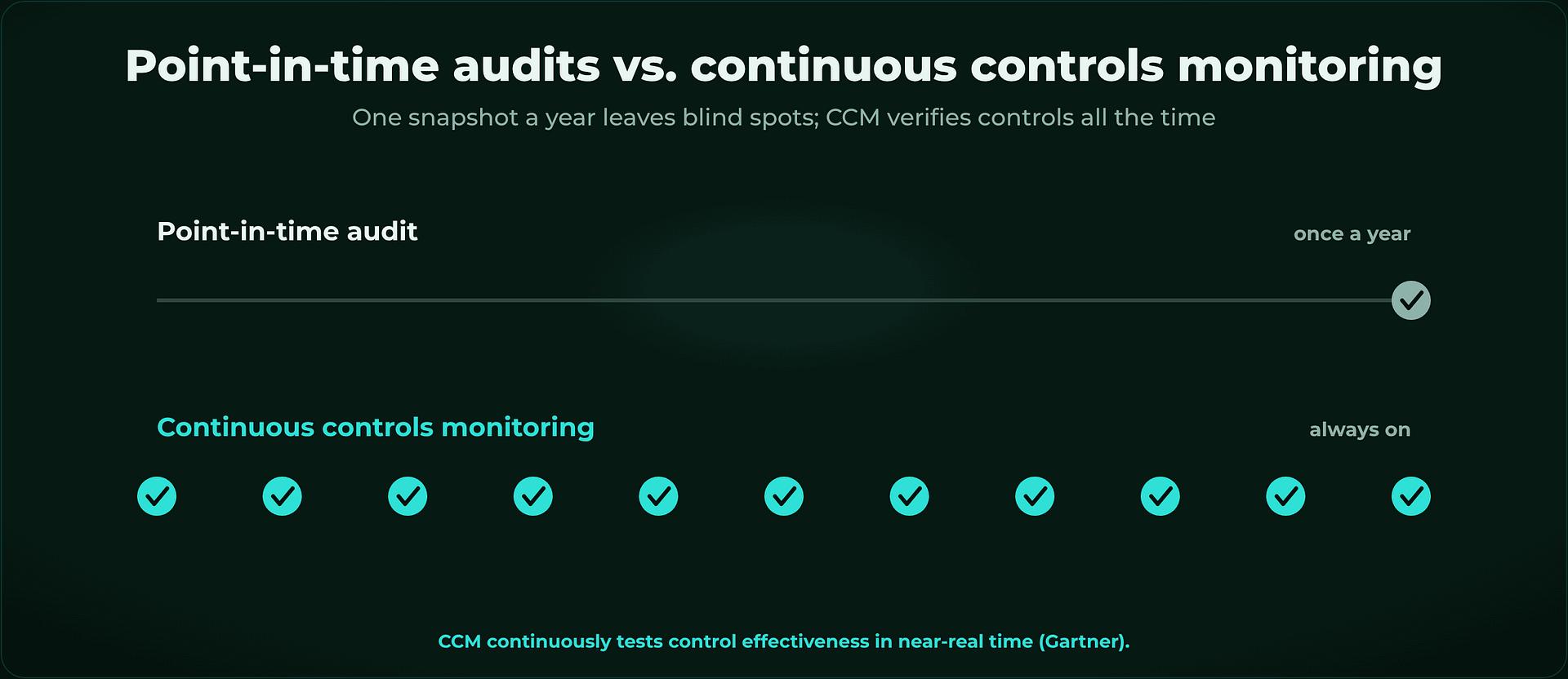
A traditional audit is a photograph: it shows that your controls worked on the days the auditor looked. CCM is a live video feed. The difference matters because risk doesn’t wait for audit season — breaches still take a mean of 241 days to identify and contain (IBM, 2025), far longer than the gaps between point-in-time reviews.
How continuous controls monitoring works
- Integrate. CCM connects to the systems where controls live — cloud infrastructure, identity providers, ticketing, HR, ERP, and security tooling.
- Test automatically. It runs control tests on a continuous schedule, comparing the live state of each system against the control’s requirement.
- Detect and alert. When a control drifts, fails, or an anomaly appears, CCM raises it immediately — with the context needed to act.
- Evidence and report. Results are captured as timestamped evidence, so audit-readiness is a byproduct rather than a project.
Why CCM matters in 2026
- Risk is continuous; audits are not. Annual reviews leave long blind spots that real-time monitoring closes.
- Manual testing doesn’t scale. With half of compliance teams spending 30–50% of their time on manual work, automated testing is the only way to cover more controls without more headcount.
- It’s the base layer for automation. You can’t safely automate response — the goal of agentic GRC — without trustworthy, continuous signal underneath.
CCM vs. related terms
| Term | What it means |
|---|---|
| Continuous controls monitoring (CCM) | Always-on testing of whether controls are working |
| Continuous compliance | Staying audit-ready at all times — CCM is a core enabler |
| Continuous auditing | Auditors using automated, ongoing testing instead of periodic sampling |
| Agentic GRC | AI agents that act on what monitoring finds, under human approval |
Frequently asked questions
What is continuous controls monitoring?
It’s technology that automatically and continuously tests whether an organization’s internal controls are effective, in real or near-real time, alerting teams to failures and anomalies before they become incidents.
How is CCM different from a SOC 2 audit?
A SOC 2 audit evaluates controls over a defined period at specific checkpoints. CCM verifies those same controls continuously, so you find problems between audits rather than discovering them during the next one.
Is CCM the same as continuous compliance?
No — CCM is a building block. Continuous compliance is the outcome of staying audit-ready at all times, and CCM is the monitoring layer that makes it possible.
Does CCM require AI?
Not strictly, but AI increasingly powers it. Gartner expects 75% of DevOps continuous-compliance automation to use AI by 2028 for testing, reporting, and remediation.
About this guide. Written by Compyl Research, drawing on Gartner’s definition of CCM and findings from IBM and Hyperproof. Compyl is an AI-powered, agentic GRC platform built by CISOs.