By Compyl Research · Last updated June 2026
Agentic GRC is an approach to governance, risk, and compliance in which AI agents continuously gather data, reason about controls and risk, and carry out routine work — such as collecting evidence, monitoring controls, and drafting responses — while humans review and approve every consequential decision. It moves GRC from periodic, manual checklists to a continuous, data-first loop where automation handles the busywork and people keep control of judgment.
Key takeaways
- Agentic GRC uses AI agents that act, not just alert — they pull live data, map it to controls, and take prepared actions under human approval.
- It is the next step beyond compliance automation: automation runs fixed rules; agentic systems reason across changing context and recommend what to do next.
- Humans stay in the loop by design. The agent proposes; an accountable owner decides. Every action is logged to an audit trail.
- The shift is being driven by real pressure: compliance teams spend 30–50% of their time on manual work, third-party breaches have doubled, and regulators are moving faster than annual audits can keep up.
- Gartner expects 33% of enterprise software applications to include agentic AI by 2028, up from less than 1% in 2024.
What is agentic GRC?
Agentic GRC applies agentic AI — AI systems that can plan and take multi-step actions toward a goal — to the work of governance, risk, and compliance. Instead of a tool that only flags a problem and waits for a person to do everything, an agentic system can connect to your environment, understand what a control requires, gather the evidence, draft the fix or the audit response, and route it to the right owner for approval.
The defining word is agentic: the software has enough context and autonomy to do the next step, not merely report that a step is needed. In a well-designed agentic GRC platform, that autonomy is deliberately bounded — the agent acts on repetitive, low-judgment work, and humans approve anything that carries real consequence.
How agentic GRC works
Agentic GRC runs as a continuous loop rather than a once-a-year scramble. A typical cycle has five stages:
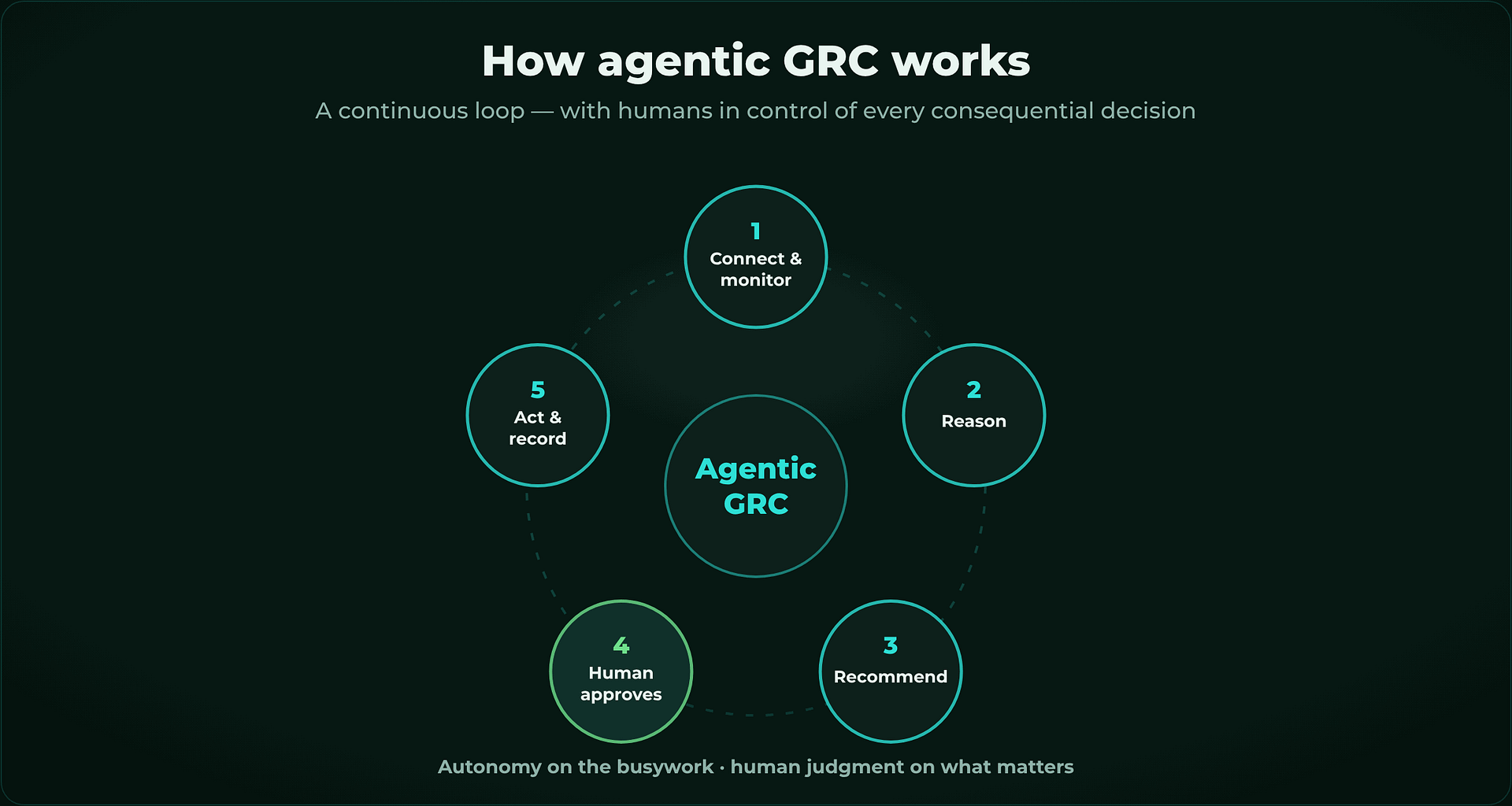
- Connect & monitor. The agent integrates with your cloud, identity, ticketing, HR, and security tools and watches them continuously — so the picture reflects today, not the last audit.
- Reason. It maps live signals to your controls and frameworks (SOC 2, ISO 27001, HIPAA, PCI DSS, NIST), identifying gaps, drift, and risk in context.
- Recommend. It drafts the output a human would otherwise build by hand — evidence, a remediation step, a control narrative, or a security-questionnaire answer.
- Human approves. An accountable owner reviews the recommendation and decides. Nothing consequential happens without that sign-off.
- Act & record. On approval, the agent executes and writes a complete, timestamped audit trail — so the work is both done and defensible.
Agentic GRC vs. compliance automation vs. traditional GRC
These terms are often used interchangeably, but they describe three different operating models:
| Dimension | Traditional GRC | Compliance automation | Agentic GRC |
|---|---|---|---|
| How work happens | Manual, spreadsheet- and ticket-driven | Fixed rules and integrations run on a schedule | Agents reason over live context and take prepared actions |
| Cadence | Point-in-time (annual / quarterly) | Continuous monitoring of known checks | Continuous monitoring and continuous response |
| Evidence | Collected by hand before each audit | Auto-collected for predefined controls | Auto-collected, drafted, and kept audit-ready |
| Handles new situations | Only if a person notices | Only if a rule already exists | Reasons about unseen cases and proposes next steps |
| Human role | Does all the work | Configures and reviews the rules | Approves consequential decisions; sets guardrails |
In short: compliance automation removes repetitive data collection; agentic GRC removes repetitive decision preparation and action — while keeping the decision itself with a person.
Why “human in the loop” is the whole point
Autonomy without accountability is a liability in compliance, where someone must always be answerable to an auditor or regulator. Done right, agentic GRC is more auditable than manual work, not less, because every recommendation, approval, and action is captured automatically.
The risk is real if it is done carelessly. Gartner projects that more than 40% of agentic AI projects will be canceled by the end of 2027, citing escalating costs, unclear business value, and inadequate risk controls. The lesson for GRC is specific: keep humans on the consequential decisions, demand a full audit trail, and be skeptical of “fully autonomous compliance” claims. The goal is autonomy on the busywork and human judgment on what matters.
Where agentic GRC is being used
- Evidence collection. Agents continuously gather and refresh evidence for SOC 2, ISO 27001, HIPAA, and other frameworks instead of teams scrambling before each audit.
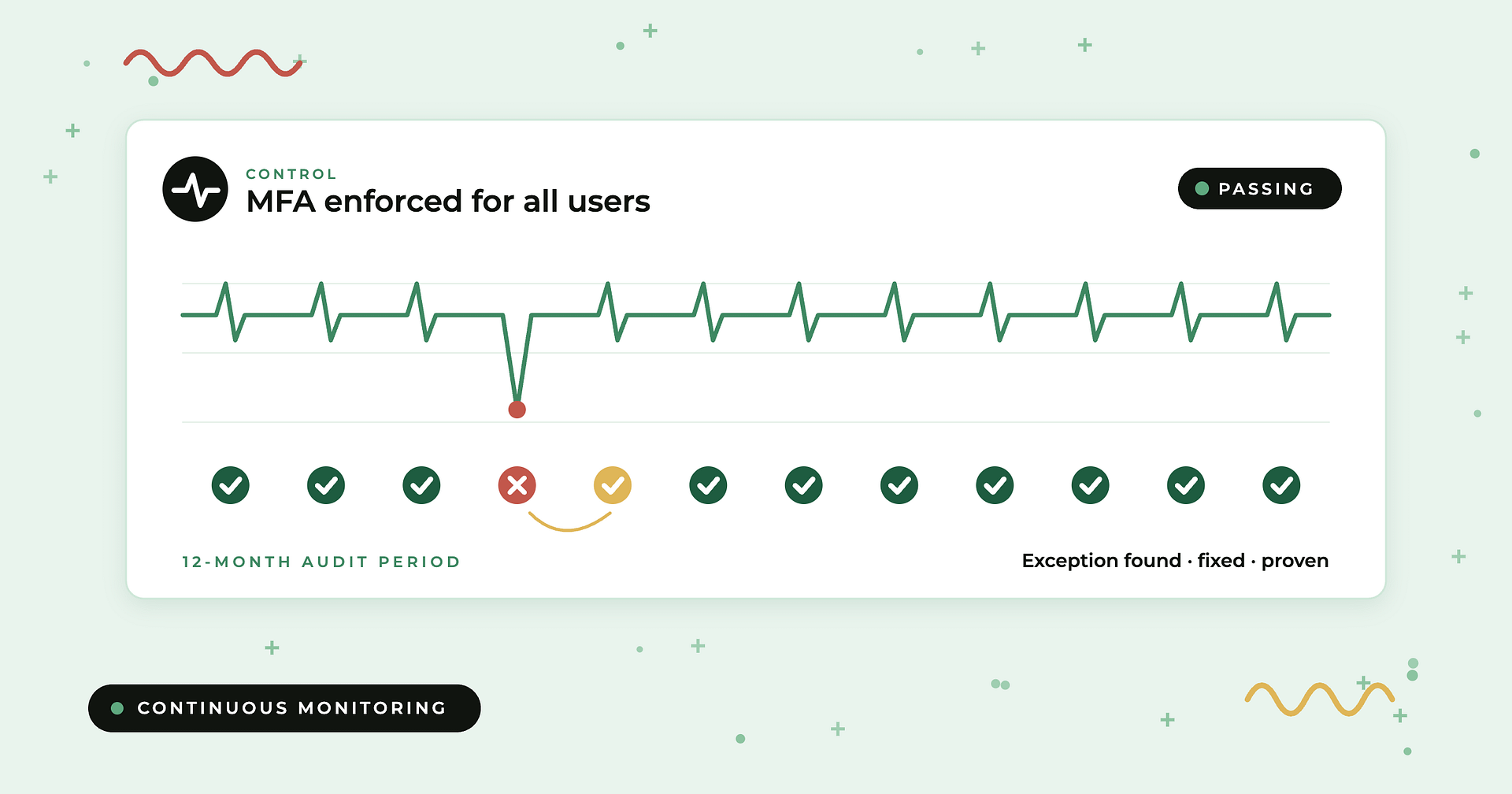
- Continuous control monitoring. Controls are checked against live system state, and drift is caught and routed for remediation as it happens.
- Risk assessment. Agents enrich and score risks from real signals, keeping the risk register current rather than stale.
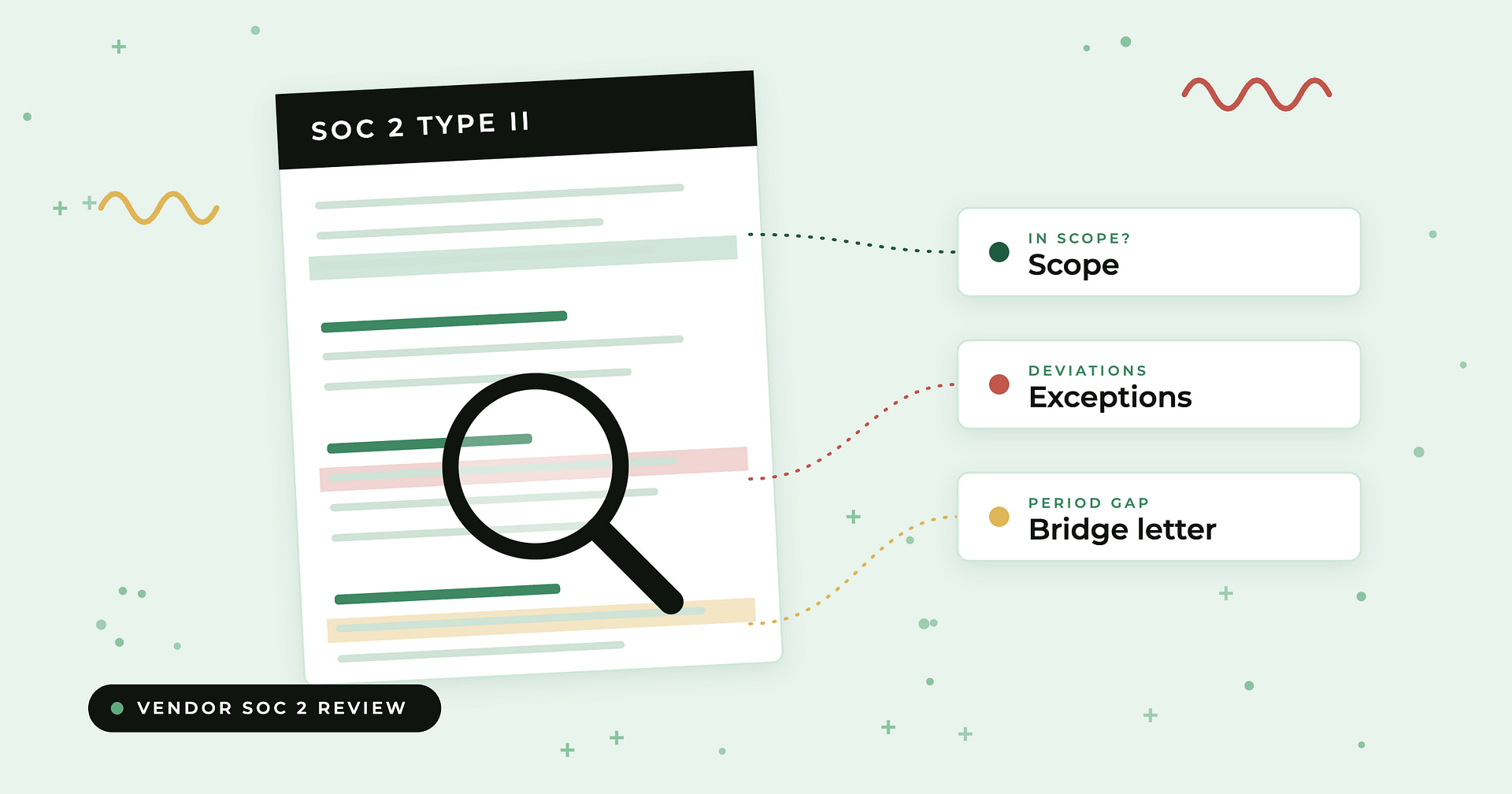
- Vendor & third-party risk. Agents track vendor posture continuously — important when third-party involvement in breaches has doubled to 30% (Verizon, 2025).
- Security questionnaires. Agents draft answers from your existing controls and evidence, compressing reviews that add two to four weeks to enterprise deals.
- Audit preparation. Evidence, narratives, and gaps are kept audit-ready year-round, turning the audit from an event into a byproduct.
Why agentic GRC is emerging now
Three forces are converging:
- The manual burden is unsustainable. Half of compliance professionals spend 30–50% of their time on manual, repetitive work — much of it generating and preserving evidence (Hyperproof, 2025).
- Risk is moving faster than annual cycles. Breaches still take a mean of 241 days to identify and contain, and U.S. breaches average $10.22 million (IBM, 2025). Point-in-time compliance cannot keep up with real-time risk.
- The technology is ready — and so is the oversight expectation. Organizations that deploy AI governance platforms are 3.4× more likely to achieve high-value AI outcomes (Gartner, 2025). Using AI to govern risk only works when the AI itself is governed.
How to evaluate an agentic GRC platform
Cut through the hype with a short checklist:
- Where does the data come from? Agentic value depends on broad, live integrations — a data-first foundation, not a thin layer over manual inputs.
- What can it actually do autonomously, and what requires approval? Be precise about the boundary between agent actions and human decisions.
- Is everything auditable? Every recommendation, approval, and action should produce an immutable, timestamped record.
- How are the agents themselves governed? Look for guardrails, role-based controls, and human review built in — not bolted on.
- Does it span the full GRC lifecycle? Point tools create new silos; the value compounds when governance, risk, and compliance share one source of truth.
Frequently asked questions
Is agentic GRC the same as compliance automation?
No. Compliance automation runs predefined rules and collects evidence for known controls. Agentic GRC adds reasoning and action — agents interpret changing context, decide what to do next, and carry out prepared steps under human approval.
Will agentic GRC replace compliance and GRC teams?
No. It removes repetitive busywork so teams can focus on judgment, strategy, and exceptions. The accountable human still owns every consequential decision, and oversight work grows as automation expands.
Is agentic GRC safe for regulated industries?
It can be safer than manual processes when designed correctly, because every action is logged to a complete audit trail and consequential decisions require human approval. The key is bounded autonomy and strong governance of the agents themselves.
What frameworks does agentic GRC support?
The model is framework-agnostic and is commonly applied to SOC 2, ISO 27001, HIPAA, PCI DSS, GDPR, NIST CSF, and emerging AI regulations such as the EU AI Act and ISO 42001.
How is agentic GRC different from “continuous compliance”?
Continuous compliance means controls are monitored continuously rather than at a point in time. Agentic GRC includes continuous monitoring but goes further — it also continuously responds, preparing and executing the work that monitoring surfaces.
The bottom line
Agentic GRC is not about handing compliance to a black box. It is about putting AI agents to work on the repetitive 30–50% of GRC that drains expert time — evidence, monitoring, drafting, and tracking — while people keep control of every decision that matters. As regulation accelerates and risk outruns annual audits, the organizations that pair agentic execution with human judgment will be the ones that stay both audit-ready and ahead of what’s next.
About this guide. Written by Compyl Research, drawing on published findings from IBM, Verizon, Gartner, and Hyperproof. Compyl is an AI-powered, agentic GRC platform built by CISOs. Figures cited reflect the most recent available data as of June 2026.