By Compyl Research · Last updated June 2026
The state of GRC in 2026 is defined by a widening gap: risk is moving in real time while most governance, risk, and compliance work is still manual and periodic. This report compiles the most recent published data on compliance automation, breach cost, third-party risk, AI adoption, and the GRC market to show where the discipline stands — and where it is heading.
Methodology: figures below are drawn from publicly available 2024–2026 research, each cited inline and listed in full at the end. This is a curated synthesis of third-party data, not a proprietary survey.
Key findings at a glance
- $4.44M — global average cost of a data breach in 2025; $10.22M in the U.S. (IBM).
- 241 days — mean time to identify and contain a breach, the lowest in nine years (IBM).
- 30% — share of breaches involving a third party, double the prior year (Verizon).
- 30–50% — the portion of their time half of compliance professionals spend on manual, repetitive work (Hyperproof).
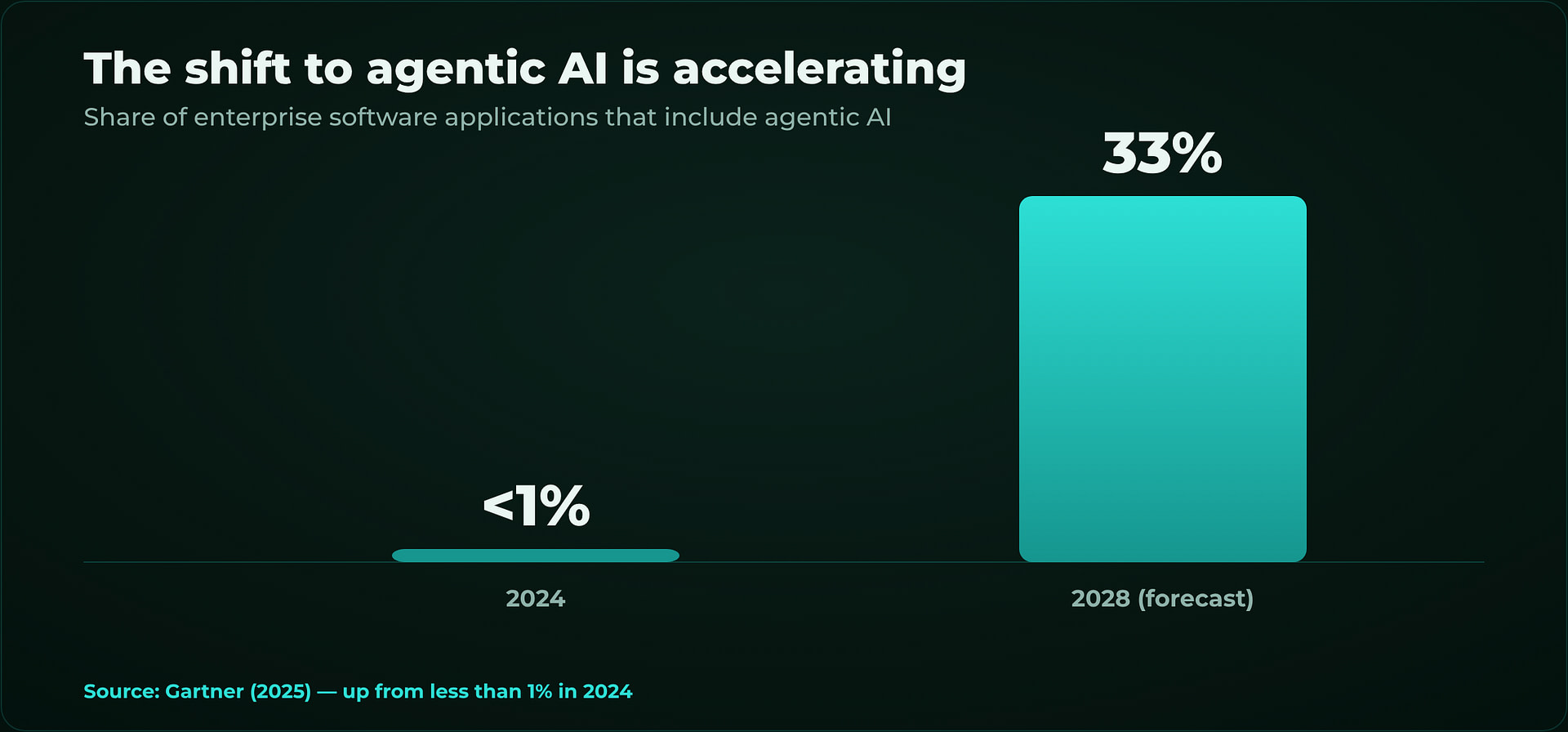
- 33% — share of enterprise software apps expected to include agentic AI by 2028, up from under 1% in 2024 (Gartner).
- $492M → $1B+ — projected AI-governance-platform spend, 2026 to 2030 (Gartner).
1. The cost of getting it wrong is concentrated—and rising in the U.S.
Globally, the average cost of a data breach actually fell 9% to $4.44 million in 2025, the first decline in years, helped by faster detection. But the headline masks where the pain is concentrated. The U.S. average climbed to $10.22 million, driven by regulatory penalties and slower detection, and healthcare remained the costliest sector at $7.42 million per breach.
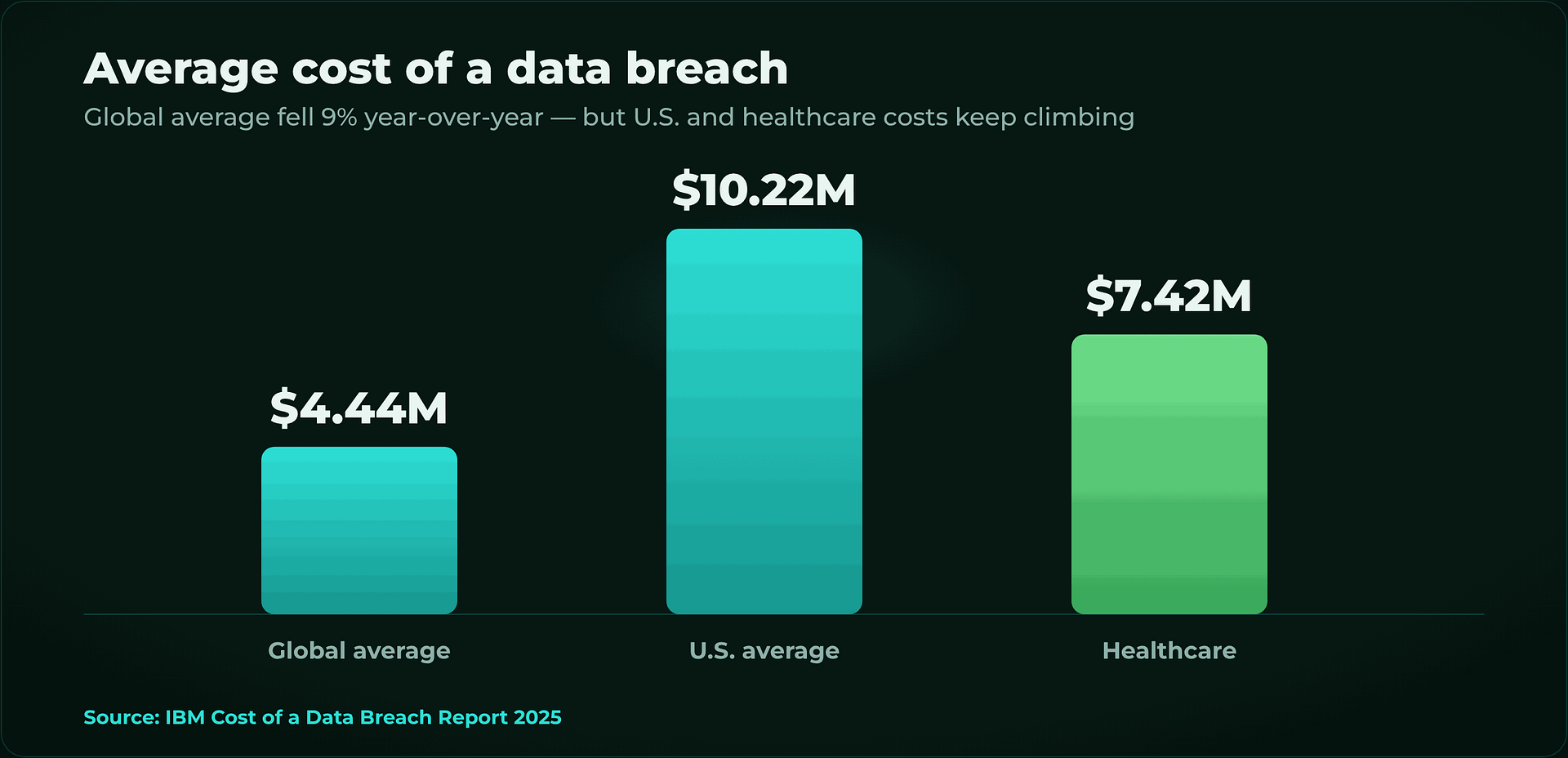
The takeaway for GRC leaders: jurisdiction and industry now matter as much as raw security posture. And while breaches take a mean of 241 days to identify and contain — the lowest in nine years — that is still eight months in which a compliance program built on annual reviews is effectively blind.
The compliance-versus-non-compliance math reinforces the point. The most-cited benchmark on the subject (Ponemon Institute / GlobalSCAPE) put the average annual cost of non-compliance at 2.7× the cost of maintaining compliance — a gap that has only widened as penalties have grown.
2. Third-party risk is now a primary breach vector
The single sharpest shift in the 2025 data: the share of breaches involving a third party doubled, from 15% to 30%, according to Verizon’s analysis of more than 12,000 confirmed breaches. Vendors, suppliers, and software supply chains are now implicated in nearly one in three breaches.
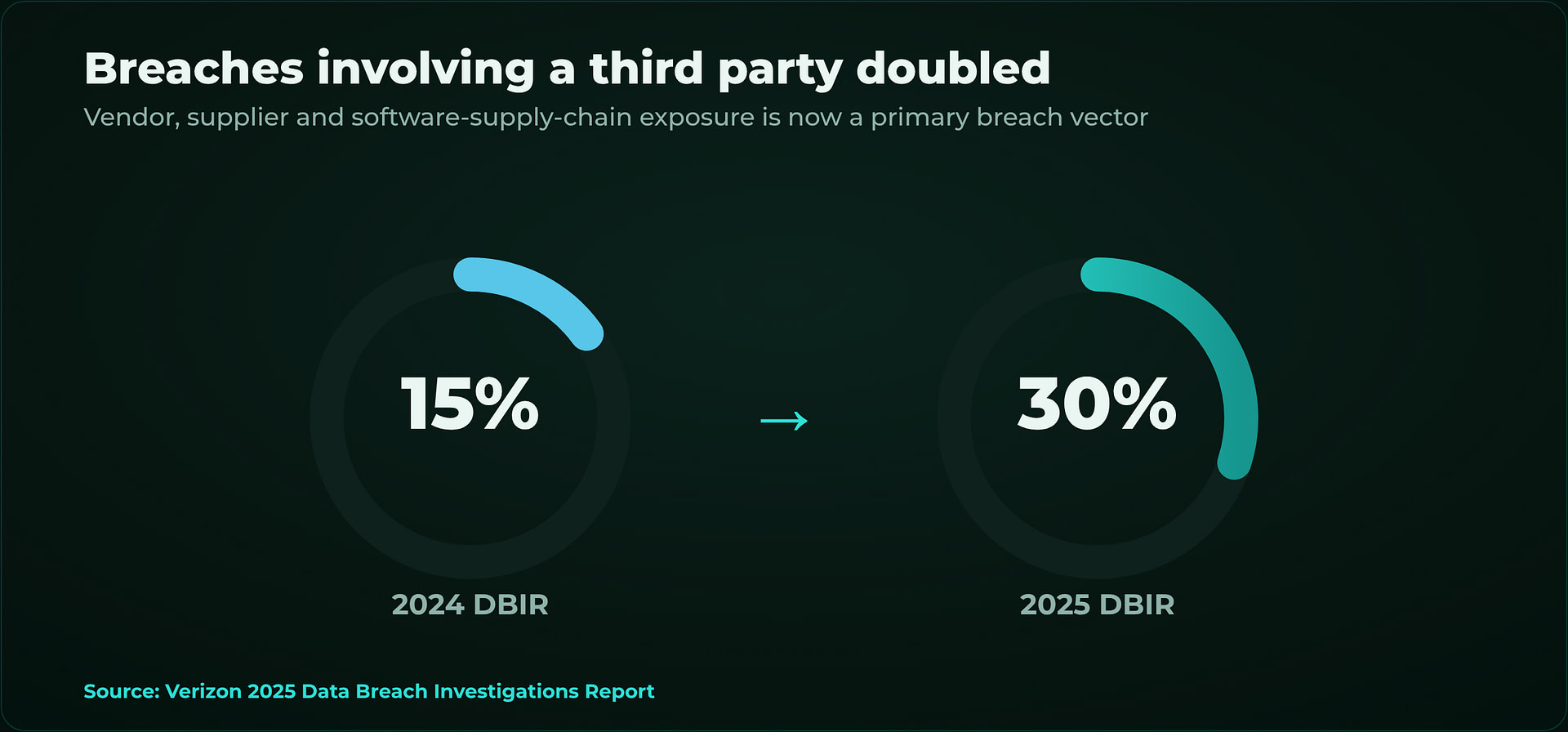
This is why vendor and third-party risk management has moved from a once-a-year questionnaire to a continuous discipline. A point-in-time vendor review tells you about a supplier’s posture on the day they filled out the form — not the day they get breached.
3. Compliance work is still overwhelmingly manual
Despite a decade of “automation,” the day-to-day reality of compliance remains manual. In Hyperproof’s 2025 IT Compliance Benchmark survey, one in two compliance professionals said they spend 30–50% of their time on manual, repetitive work — much of it generating and preserving evidence of security and data-protection controls.
The burden is amplified by the pace of regulation. Thomson Reuters Regulatory Intelligence has tracked 200+ regulatory updates per day on average, and roughly a quarter of firms report spending a full day each week just tracking regulatory change. Manual programs were not built for that velocity.
It shows up in revenue, too: security questionnaires, SOC 2 reviews, and vendor assessments now add two to four weeks to mid-market and enterprise deals — friction that lands squarely on already-stretched compliance teams.
4. AI is the inflection point—on both sides of the ledger
AI is reshaping GRC as both a risk to govern and a tool to do the governing.
On the tooling side, the move to agentic systems is fast. Gartner expects 33% of enterprise software applications to include agentic AI by 2028, up from less than 1% in 2024, and at least 15% of day-to-day work decisions to be made autonomously by then. The payoff is already measurable in security: organizations using AI and automation extensively cut their breach lifecycle by 80 days and saved nearly $1.9 million on average (IBM).
On the governance side, AI is creating a brand-new compliance domain. Gartner projects spending on AI governance platforms will reach $492 million in 2026 and surpass $1 billion by 2030, and that fragmented AI regulation will extend to 75% of the world’s economies by 2030. Crucially, organizations that deploy AI governance platforms are 3.4× more likely to achieve high-value AI outcomes — evidence that governing AI well is a competitive advantage, not just a cost.
A caution sits alongside the optimism: Gartner also expects more than 40% of agentic AI projects to be canceled by the end of 2027, citing unclear value and inadequate risk controls. The winners will be the programs that pair automation with disciplined human oversight.
5. The workforce can’t scale the old way
The people side explains why automation is no longer optional. In ISC2’s 2025 Cybersecurity Workforce Study, 95% of respondents reported at least one skills gap, and 59% cited critical or significant skills needs — up from 44% a year earlier. Nearly 90% experienced a significant security event tied to those gaps. Tellingly, AI is now the single most in-demand skill (41% of respondents), ahead of cloud security.
Teams are being asked to cover more frameworks, more vendors, and faster-moving regulation without proportional headcount. That arithmetic only resolves one way: shifting repetitive work to automation so scarce expertise goes to judgment.
6. The market is voting with its budget
Spending reflects the urgency. The enterprise GRC market was estimated at roughly $72 billion in 2025, growing toward $83 billion in 2026 (Grand View Research), and the GRC software segment specifically is forecast to grow from about $21 billion in 2025 to $39 billion by 2031 at a ~11% CAGR (Mordor Intelligence). Compliance is increasingly treated as a strategic asset rather than a cost center.
What it means for 2026
- Continuous beats point-in-time. With breaches taking 241 days to contain and third-party exposure doubling, annual reviews leave too much blind time. Continuous monitoring is becoming the baseline.
- Automation is now a workforce necessity, not a nice-to-have. A 30–50% manual workload against a 95% skills-gap backdrop is unsustainable without it.
- Governing AI is the new compliance frontier. The teams that get ahead of the EU AI Act, ISO 42001, and NIST’s AI Risk Management Framework will avoid a scramble later.
- Oversight is the differentiator. With 40%+ of agentic AI projects projected to fail, the advantage goes to programs that combine automation with accountable human control.
Frequently asked questions
What is the average cost of a data breach in 2026?
The most recent figure is from 2025: a global average of $4.44 million and a U.S. average of $10.22 million, per IBM’s Cost of a Data Breach Report. Updated 2026 figures are expected later in the year.
How much of compliance work is still manual?
According to Hyperproof’s 2025 benchmark, half of compliance professionals spend 30–50% of their time on manual, repetitive work — largely evidence collection and audit preparation.
How big is the GRC market?
Estimates vary by scope. The broad enterprise GRC market is around $72–83 billion (2025–2026), while the GRC software segment is roughly $21–23 billion and growing about 11% per year toward $39 billion by 2031.
Why is third-party risk such a focus in 2026?
Because third-party involvement in breaches doubled to 30% in Verizon’s 2025 report — vendors and software supply chains are now implicated in nearly a third of breaches.
Sources
- IBM, Cost of a Data Breach Report 2025.
- Verizon, 2025 Data Breach Investigations Report.
- Gartner, agentic AI adoption forecasts and AI governance platform market (2025–2026).
- Hyperproof, 2025 IT Compliance Benchmark Survey.
- ISC2, 2025 Cybersecurity Workforce Study.
- Thomson Reuters, Cost of Compliance / Regulatory Intelligence.
- Ponemon Institute & GlobalSCAPE, The True Cost of Compliance.
- Grand View Research, Enterprise GRC Market; Mordor Intelligence, GRC Software Market.
About this report. Compiled by Compyl Research from publicly available 2024–2026 sources, each cited above. Compyl is an AI-powered, agentic GRC platform built by CISOs. Figures reflect the most recent available data as of June 2026 and will be refreshed as new reports are published.