Last updated: June 2, 2026
Author: Daniel Tangney
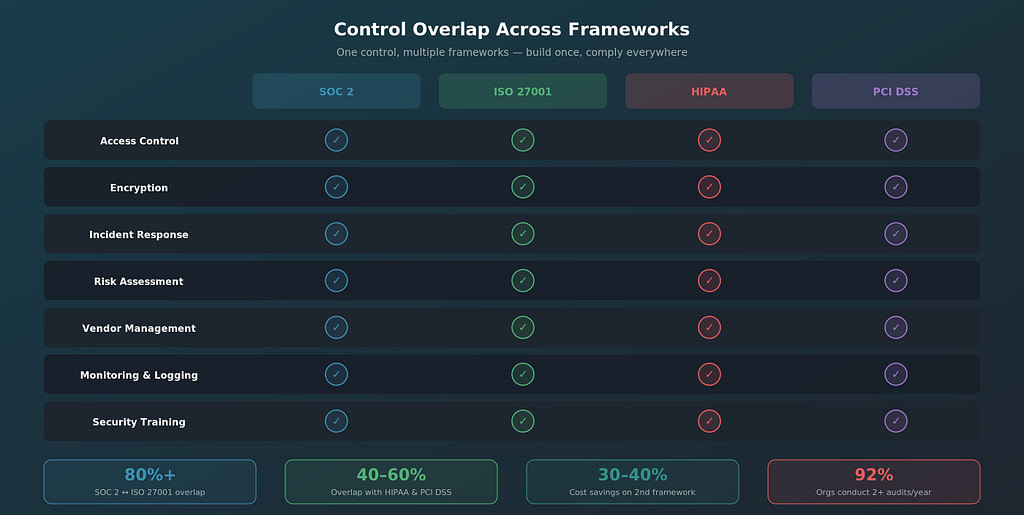
Choosing the right compliance framework is one of the most consequential decisions a mid-market company makes — and most companies get it wrong. Not because they pick the wrong framework, but because they treat each one as a standalone project instead of recognizing that SOC 2, ISO 27001, HIPAA, and PCI DSS share 70–80% of the same underlying controls.
For mid-market companies (100–1,000 employees), the question is rarely “which one?” — it is “which one first, and how do I build a foundation that makes the next framework 40% easier?”
This guide compares the four frameworks side by side: what each requires, what it costs, how long it takes, where they overlap, and how to sequence them based on your industry, customers, and growth trajectory. Every data point is sourced and current as of 2026.
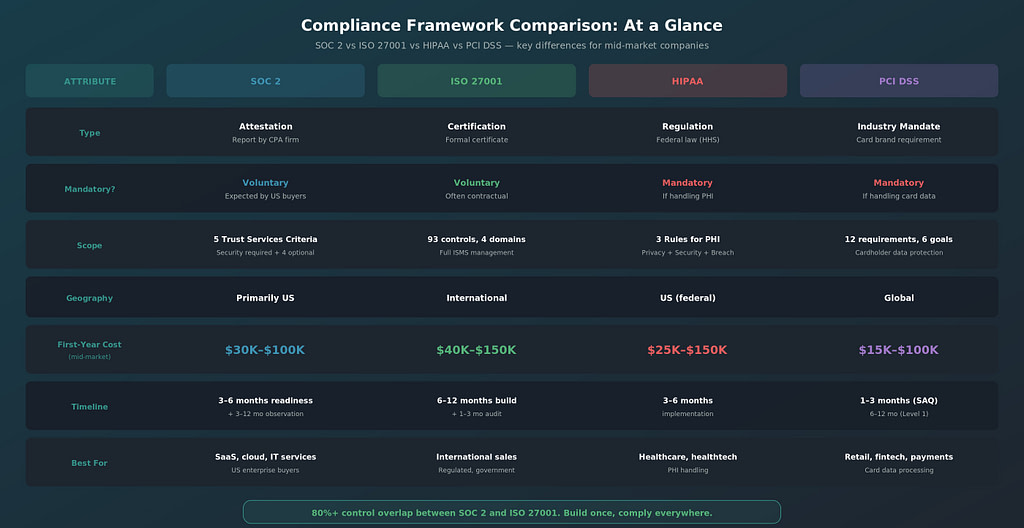
The Four Frameworks at a Glance
| SOC 2 | ISO 27001 | HIPAA | PCI DSS | |
|---|---|---|---|---|
What Each Framework Actually Requires
SOC 2
SOC 2 is an attestation — not a certification. A licensed CPA firm audits your organization against the AICPA’s Trust Services Criteria and produces a report describing your controls and their operating effectiveness. There is no pass/fail; the auditor issues an opinion (unqualified, qualified, adverse, or disclaimer).
Two report types: Type I evaluates control design at a single point in time. Useful for demonstrating readiness, but most enterprise buyers require Type II. Type II evaluates control design and operating effectiveness over a period (typically 3–12 months). This is what buyers expect.
What is audited: Only the Security criterion is mandatory. The four additional criteria — Availability, Processing Integrity, Confidentiality, and Privacy — are optional and selected based on your service and customer requirements. Most mid-market SaaS companies include Security plus one or two additional criteria.
2026 update: The core Trust Services Criteria remain unchanged since 2017, but the AICPA has revised its points of focus to address emerging technologies. Auditors in 2026 expect evidence of risk-based authentication, defined RTOs and RPOs, API security controls, and continuous monitoring capabilities.
Who needs it: 91% of US organizations pursuing repeatable compliance start with SOC 2 (Vanta 2025 State of Compliance). If you sell B2B software or services to US enterprise customers, SOC 2 Type II is effectively mandatory — not by regulation, but by procurement requirement.
ISO 27001
ISO 27001 is a formal certification issued by an accredited certification body. It requires establishing, implementing, maintaining, and continually improving an Information Security Management System (ISMS) — a systematic approach to managing sensitive information.
What is audited: The ISO 27001:2022 standard includes 93 controls organized across four domains: Organizational (37 controls), People (8 controls), Physical (14 controls), and Technological (34 controls). The 2022 revision added 11 new controls covering cloud security, threat intelligence, data masking, ICT readiness for business continuity, and information security for cloud services.
Audit structure: Stage 1 (Documentation Review) reviews your ISMS documentation, scope, risk assessment methodology, and Statement of Applicability. Stage 2 (Certification Audit) assesses control implementation and effectiveness. Annual surveillance audits occur during the 3-year certification cycle, with full recertification every 3 years.
2026 update: The transition deadline from ISO 27001:2013 to ISO 27001:2022 passed on October 31, 2025. All ISO 27001:2013 certifications are now expired. Any organization pursuing ISO 27001 certification in 2026 must certify under the 2022 version.
Who needs it: 81% of organizations report current or planned ISO 27001 certification in 2025, up from 67% in 2024. If you sell internationally, pursue government contracts, or operate in financial services, ISO 27001 certification is often a contractual requirement. Over 150,000 organizations hold ISO 27001 certificates globally, and the market is growing at 14.2% CAGR through 2032.
HIPAA
HIPAA is not a certification or attestation — it is a federal regulatory requirement enforced by the Office for Civil Rights (OCR). There is no “HIPAA certified” designation. Compliance is demonstrated through ongoing adherence to the Privacy Rule, Security Rule, and Breach Notification Rule.
Who it applies to: Covered entities (health plans, healthcare providers, clearinghouses) and business associates — any vendor, subcontractor, or service provider that creates, receives, maintains, or transmits protected health information (PHI) on behalf of a covered entity. If you are a SaaS company and a hospital uses your software, you are a business associate.
Key requirements: The Privacy Rule governs the use and disclosure of PHI. The Security Rule requires administrative, physical, and technical safeguards to protect electronic PHI. The Breach Notification Rule requires notification to affected individuals within 60 days for breaches affecting 500+ individuals.
2026 update: In January 2025, HHS published a 125-page Notice of Proposed Rulemaking proposing the first major Security Rule overhaul since 2003. The proposed changes eliminate the “required” vs. “addressable” distinction, making nearly all safeguards mandatory. OCR’s Risk Analysis Initiative has produced 11 enforcement actions by early 2026.
Enforcement: OCR collected over $9.9 million across 22 enforcement actions in 2024. In the first five months of 2025, OCR announced 10 resolution agreements with fines ranging from $25,000 to $3 million. Current penalty tiers (effective January 28, 2026): Tier 1 starts at $145 per violation, Tier 4 caps at $2,190,294 per violation annually.
PCI DSS
PCI DSS (Payment Card Industry Data Security Standard) is an industry mandate enforced through contractual obligations from payment card brands (Visa, Mastercard, American Express, Discover, JCB). Non-compliance results in fines from your acquiring bank, increased transaction fees, and potential loss of card processing privileges.
Who it applies to: Any organization that stores, processes, or transmits cardholder data — merchants, service providers, payment processors, and any third party in the payment chain.
| Level | Transaction Volume | Validation Requirement |
|---|---|---|
PCI DSS v4.0 key changes: Version 4.0 introduced 64 new requirements. The final 51 “future-dated” requirements became mandatory on March 31, 2025. Key changes: MFA required for all access to the cardholder data environment (not just admin), targeted risk analysis replacing fixed-schedule checks, enhanced anti-phishing controls, and stronger encryption requirements.
Enforcement: Non-compliance penalties range from $5,000 to $10,000 per month, escalating to $100,000 per month after six months. The average data breach cost in 2024 was $4.88 million — a 10% year-over-year increase (IBM/Ponemon 2024).
What Each Framework Costs for Mid-Market Companies
Cost is one of the most common questions — and one of the most misunderstood. The audit fee is only part of the picture. The total cost includes readiness work, tooling, remediation, and ongoing maintenance.
| Cost Component | SOC 2 Type II | ISO 27001 | HIPAA | PCI DSS |
|---|---|---|---|---|
The multi-framework discount: Using a unified control library and GRC platform, the second framework typically costs 30–40% less than the first due to shared controls. In 2025, 92% of organizations conducted at least two compliance audits, and 58% conducted four or more. Building a reusable control foundation is not optional — it is the only way to scale compliance without scaling headcount.
Where the Controls Overlap
This is the most important section of this guide. The four frameworks are not four separate projects — they are four views of largely the same underlying security controls.
Control overlap by domain
| Control Domain | SOC 2 | ISO 27001 | HIPAA | PCI DSS |
|---|---|---|---|---|
The takeaway: AICPA’s own mapping shows 80%+ overlap between SOC 2 and ISO 27001 at the control level. Teams typically reuse 80–96% of the same evidence across both frameworks. A single encryption-at-rest policy can simultaneously satisfy SOC 2 CC6.1, ISO 27001 A.8.24, HIPAA §164.312(a)(2)(iv), and PCI DSS Requirement 3.
What this means for your budget: If your first framework costs $80,000 to implement, the second should cost closer to $50,000 — not another $80,000 — because you are extending controls, not rebuilding them.
The Decision Framework: Which Framework Comes First?
The framework you start with depends on three factors: regulatory obligation, customer requirements, and growth trajectory.
Mandatory first
If you are legally or contractually required to comply with a framework, that framework comes first — regardless of other considerations.
- You handle protected health information (PHI) → HIPAA first. This is a regulatory requirement with enforcement teeth. OCR does not accept “we are working on it” as a defense.
- You process, store, or transmit cardholder data → PCI DSS first. Your acquiring bank and payment brands can terminate your processing privileges for non-compliance.
Then follow your customer requirements
If no framework is legally mandatory for your business:
- Your customers are primarily US enterprise buyers → SOC 2 first. 91% of US organizations pursuing repeatable compliance start with SOC 2. It is the de facto requirement in US B2B procurement.
- Your customers include international companies or government entities → ISO 27001 first. Certification carries more weight outside the US and in regulated sectors.
- Your customers require both → Start with whichever your next major deal requires. The 80%+ control overlap means the second framework builds on the first.
Sequencing for multi-framework compliance
For a mid-market company with no immediate regulatory mandate:
Quarter 1–2: SOC 2 Type I (establishes your control baseline, fastest to achieve, most US buyer impact)
Quarter 3–4: SOC 2 Type II observation period begins. Simultaneously begin ISO 27001 ISMS development (leverage existing SOC 2 controls — 80%+ overlap)
Quarter 5–6: SOC 2 Type II report issued. ISO 27001 Stage 1 + Stage 2 audit.
Ongoing: Add HIPAA or PCI DSS as business requirements dictate. With SOC 2 and ISO 27001 in place, adding a third framework is primarily a scoping and gap-fill exercise, not a ground-up build.
Common Mistakes Mid-Market Companies Make
Building each framework from scratch. The most expensive mistake is treating each framework as an independent project with its own policies, controls, and evidence. A unified control library maps once and satisfies multiple frameworks — an encryption policy does not need to be written four times.
Starting with the wrong framework. Choosing ISO 27001 when all your customers are US SaaS buyers (who want SOC 2) wastes 6–12 months of effort on a certificate that does not unlock revenue. Conversely, pursuing SOC 2 when your buyers are European banks (who want ISO 27001) misses the market.
Underestimating ongoing costs. The first-year cost gets all the attention. But SOC 2 requires annual audits, ISO 27001 requires annual surveillance, and HIPAA requires ongoing risk analysis. Budget for the second year on day one.
Manual evidence collection. Mid-market compliance teams of 1–3 people cannot manually collect evidence across four frameworks. Compliance automation platforms reduce evidence collection effort by 30–50% — and the gap between manual and automated widens with every additional framework.
Treating compliance as a one-time project. Compliance is a continuous operating model, not a project with a finish line. The organizations that struggle most are those who sprint to pass an audit, then let controls degrade until the next audit cycle.
Ignoring the multi-framework path. 92% of organizations conduct at least two compliance audits annually. If you are pursuing SOC 2 today, you will likely need ISO 27001 within two years. Build your control foundation with reuse in mind from day one.
How Compyl Simplifies Multi-Framework Compliance
The framework above works at any scale — but for a mid-market compliance team of 1–3 people managing two or more frameworks, the right platform makes the difference between scaling with headcount and scaling with automation.
Cross-framework control mapping: Compyl maps controls across 80+ frameworks, so a single control satisfies SOC 2, ISO 27001, HIPAA, and PCI DSS simultaneously. When you implement an encryption policy for SOC 2, Compyl automatically maps it to the corresponding ISO 27001, HIPAA, and PCI DSS requirements — no duplicate work.
Automated evidence collection: Compyl integrates natively with your existing tech stack — AWS, Azure, GCP, Okta, CrowdStrike, Jira, GitHub, Slack, M365, and more — to continuously collect evidence. Instead of spending weeks gathering screenshots before an audit, evidence is collected automatically on a frequency you define.
Framework-specific audit readiness: Whether you are preparing for a SOC 2 Type II report, ISO 27001 Stage 2 audit, or an OCR HIPAA review, Compyl provides the exact evidence package auditors expect. Dashboards show real-time compliance status across every framework you are pursuing.
Compyl’s unique query language: Cross-references data from multiple integrated sources to uncover granular details that manual reviews miss. Queries run on a custom frequency — daily, weekly, or triggered by events — so compliance monitoring is continuous, not periodic.
One platform, not four tools: Rather than stitching together a SOC 2 tool, an ISO 27001 tool, a HIPAA compliance tracker, and a PCI DSS assessment platform, Compyl provides a single, integrated GRC platform. One vendor inventory, one risk register, one policy library, one evidence repository — all mapped to every framework you need.
Frequently Asked Questions
Which compliance framework should a SaaS company get first?
For US-focused B2B SaaS companies, SOC 2 Type II should be the first framework. It is the most commonly requested compliance report in US enterprise procurement — 91% of organizations pursuing repeatable compliance start with SOC 2. A SOC 2 Type I report can be achieved in 3–6 months and demonstrates control design, while the Type II report (which evaluates operating effectiveness over time) is what most enterprise buyers ultimately require. Once SOC 2 is in place, ISO 27001 is the natural second framework, with 80%+ control overlap accelerating the process.
How much does SOC 2 compliance cost for a mid-market company?
For a mid-market company (100–1,000 employees), first-year SOC 2 Type II costs typically range from $30,000 to $100,000, including audit fees ($20,000–$60,000), compliance automation tooling, readiness consulting, and remediation work. Annual renewal costs drop to $15,000–$40,000 once the foundational controls are in place. Using a compliance automation platform can reduce total costs by 30–50% compared to a fully manual approach.
What is the difference between SOC 2 and ISO 27001?
SOC 2 is an attestation report produced by a licensed CPA firm, governed by the AICPA, primarily recognized in the US, and must be renewed annually. ISO 27001 is a formal certification issued by an accredited certification body, governed by ISO/IEC, recognized internationally, and valid for three years with annual surveillance audits. SOC 2 evaluates your controls against Trust Services Criteria (with only Security being mandatory). ISO 27001 requires implementing a comprehensive Information Security Management System (ISMS) with 93 controls. Despite these differences, the two frameworks share 80%+ control overlap — an organization that has achieved one is well-positioned to achieve the other.
Is HIPAA compliance required for SaaS companies?
HIPAA compliance is required for any SaaS company that qualifies as a business associate — meaning any entity that creates, receives, maintains, or transmits protected health information (PHI) on behalf of a covered entity (hospitals, health plans, healthcare providers). If a healthcare organization uses your software and patient health data passes through your systems, you are a business associate and must comply with HIPAA. This applies even if you only store or transmit the data temporarily. HIPAA is a regulatory requirement enforced by the Office for Civil Rights (OCR), not a voluntary framework, and penalties for non-compliance can reach $2,190,294 per violation per year.
How long does it take to get ISO 27001 certified?
For a mid-market company starting from scratch, ISO 27001 certification typically takes 9–15 months. This includes 6–12 months to build and implement the ISMS (policies, risk assessment, control implementation, internal audit), followed by 1–3 months for the Stage 1 (documentation review) and Stage 2 (certification audit) assessments. Companies that already have SOC 2 in place can often compress this to 6–9 months by leveraging existing controls — the 80%+ overlap means much of the foundational work is already done.
Can you pursue multiple compliance frameworks at the same time?
Yes, and for mid-market companies, pursuing frameworks in parallel is often more efficient than sequentially. The key is building a unified control library where each control maps to all applicable frameworks. An encryption-at-rest control, for example, simultaneously satisfies SOC 2 CC6.1, ISO 27001 A.8.24, HIPAA §164.312(a)(2)(iv), and PCI DSS Requirement 3. In 2025, 92% of organizations conducted at least two compliance audits, and 58% conducted four or more. Using a GRC platform with cross-framework mapping, the second framework typically costs 30–40% less than the first.
What changed in PCI DSS v4.0?
PCI DSS v4.0 introduced 64 new requirements beyond v3.2.1. The final 51 “future-dated” requirements became mandatory on March 31, 2025. Key changes include: multi-factor authentication required for all access to the cardholder data environment (not just administrative access), targeted risk analysis replacing fixed-schedule vulnerability checks, enhanced anti-phishing controls, stronger encryption requirements, and a new customized approach option that allows organizations to meet objectives through alternative controls. Version 4.0.1 (released June 2024) was a clarification update with no new requirements.
How do compliance frameworks overlap with each other?
The four major frameworks share significant control overlap, concentrated in access control, encryption, incident response, risk assessment, vendor management, change management, monitoring/logging, physical security, and security awareness training. AICPA’s own mapping shows 80%+ overlap between SOC 2 and ISO 27001 at the control level. SOC 2 and ISO 27001 share approximately 40–60% overlap with HIPAA and PCI DSS, primarily because the industry-specific frameworks add domain-specific requirements (PHI handling for HIPAA, cardholder data protection for PCI DSS) on top of the shared security baseline. Organizations using a GRC platform with cross-framework control mapping report reusing 80–96% of evidence across SOC 2 and ISO 27001.