The best trust center software in 2026 depends on where your security data already lives. If you run a full GRC program, a GRC platform with a built-in trust center, such as Compyl Trust Center, publishes live control status, gated documents and questionnaire answers from the same system your auditors use. If you are earning a first SOC 2, the compliance-automation platforms (Vanta, Drata, Secureframe, Sprinto, Scrut, Thoropass) bundle a trust center with readiness. Standalone tools (Conveyor, Whistic, TrustCloud) fit teams whose main problem is security-review volume rather than the compliance program behind it.
The demand is real. In Secureframe’s October 2026 trust center explainer, which draws on its 2026 Cybersecurity and Compliance Benchmark Report, 70% of organizations said they still rely heavily on questionnaires and RFPs and 73% said they regularly need to share a third-party audit report. Only 31% already use trust pages or security dashboards. SecurityPal, analyzing thousands of real security reviews, reports that questionnaires now average nearly 100 questions and that trust centers “have shifted from a differentiator to a baseline expectation.”
Key takeaways
- A trust center is a self-service page where buyers get your security documentation, certifications, subprocessor list and control status without emailing your security team. If you need the basics first, start with what a trust center is.
- Trust center software falls into three categories: GRC platforms with a built-in trust center, compliance-automation platforms with a trust center add-on, and standalone trust center or security review tools.
- The deciding question is where the content comes from. A trust center fed by live controls stays current. One maintained by hand goes stale between audits.
- A trust center works best alongside questionnaire automation. The documents you publish answer the routine questions, and the questionnaire tool drafts answers to the rest from the same evidence.
- Buyers now ask how you govern AI as well as how you secure data, so plan for AI-security disclosures on your trust center.
What are the main types of trust center software?
Most “best trust center” lists put every vendor in one ranking. That hides the most important difference between them: whether the trust center is a view of a live compliance program or a separate content repository. The table below compares the three categories.
| Category | Examples | Strong at | Blind spot | Best fit |
|---|---|---|---|---|
| GRC platform with built-in trust center | Compyl, Hyperproof | Publishing live control status, policies and subprocessors straight from the system of record, across many frameworks, risk and vendor programs | No structural blind spot. Breadth follows the sources connected to it | 200 to 1,000-employee companies running several frameworks with a real GRC function |
| Compliance-automation platform with trust center | Vanta, Drata, Secureframe, Sprinto, Scrut, Thoropass | Fast time to launch after a first SOC 2 or ISO 27001, with control status pulled from the readiness tool | The trust center reflects what the automation platform monitors. Risk, vendor and policy depth varies by vendor | Startups and growth-stage SaaS companies working toward their first audits |
| Standalone trust center and security review tools | Conveyor, Whistic, TrustCloud (SafeBase, now part of Drata) | Security-review workflow: access requests, NDAs, CRM-connected deal flow, AI questionnaire answering | Content is only as current as the knowledge base someone maintains. No control or audit data behind it unless connected | Teams with high questionnaire volume whose compliance program runs in another tool |
What should a trust center include?
A trust center has to answer the questions a buyer’s security reviewer would otherwise send you in a spreadsheet. In practice, these elements matter most.
- Security documentation. SOC 2 Type II reports, ISO 27001 certificates, penetration test summaries, HIPAA or PCI attestations and policy summaries. A common pattern is to make certificates public and gate full reports.
- NDA-gated access. Visitors request a sensitive document, accept an NDA online and get access approved, ideally with expiry dates and a log of every grant. As CPA firm Withum explains, a SOC 2 report is a restricted-use report, while a SOC 3 is general-use, so the SOC 2 belongs behind a gate. See whether a SOC 2 report is enough on its own.
- Subprocessor list. Each third party that touches customer data, with its purpose and data location. Privacy reviewers look for it early, and it should come from your vendor inventory, not a hand-edited page.
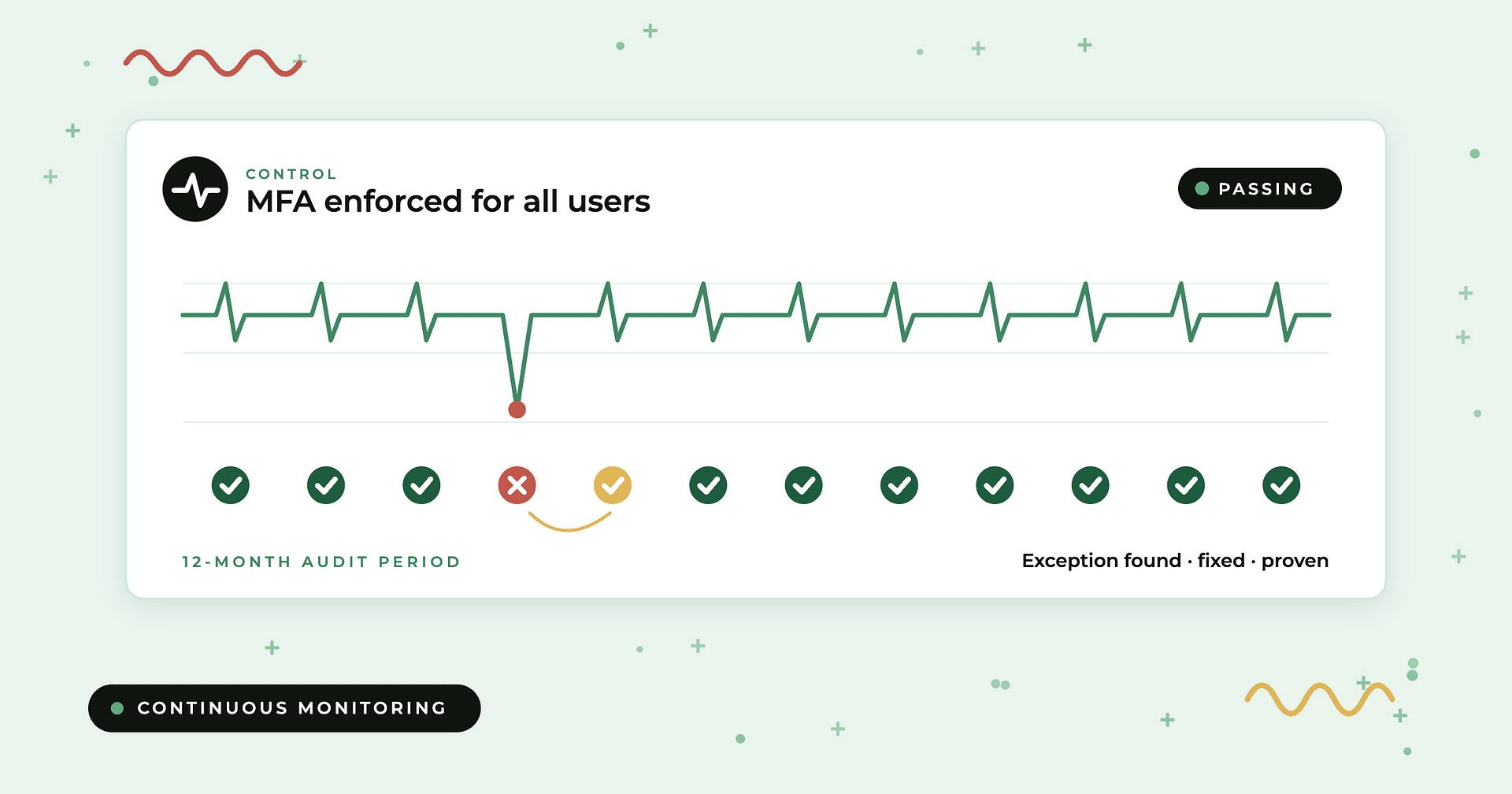
- Live control status. A current view of controls and framework coverage, published from the compliance system, so buyers see your state today rather than at your last audit.
- Questionnaire deflection. An FAQ or knowledge base that answers common questions directly, plus completed standard questionnaires (SIG, CAIQ) that buyers can download instead of sending their own.
- AI-security disclosures. How you use AI in your product, what customer data reaches models, and how models are governed. SecurityPal’s 2026 analysis notes that buyers now want to know “how models are governed, constrained, audited, and supervised.” Sprinto’s trust center page already advertises displaying a “security and AI safety posture.”
- Change log and subscriptions. A way for existing customers to be notified when a report renews or a subprocessor changes.
Which GRC platforms offer built-in trust center capabilities?
These platforms run the whole program (controls, risk, vendors, policies, audits) and publish the trust center from that data. Nothing has to be copied into a separate tool.
Compyl Trust Center
Best for: mid-market companies (200 to 1,000 employees) that want one trust center fed directly by their GRC program across many frameworks, with questionnaire automation built in.
Compyl Trust Center is a branded page on your own domain, so there is no microsite to build. Control status is published from the GRC platform. Because Compyl keeps one control library cross-mapped across 70+ frameworks, a single control update shows up correctly whether a buyer is checking SOC 2, ISO 27001, HIPAA or PCI DSS. Each document can be public or restricted. Gated items, such as a SOC 2 Type II report, sit behind a request, an NDA or an approval, and you approve in one click. Every grant is logged for GDPR, CCPA and your own retention rules, and access can be time-limited.
The subprocessor list comes from the same records your team uses for vendor risk management, so it stays accurate as vendors are added or retired. Public policy summaries come from the approved versions in Compyl’s policy management, and a change log with subscriptions keeps existing customers informed. When a buyer sends a questionnaire anyway, Questionnaire Assist pre-answers it from the same evidence, and a person approves every answer before it goes out. That is Compyl’s “Intentional AI” approach.
The evidence underneath is gathered through 125+ in-house integrations included at no extra cost, with transparent evidence logic rather than a black box. Each customer gets a dedicated single-tenant environment. That matters for a trust center: the security posture you show buyers should be backed by architecture you’d be comfortable showing them too. Compyl doesn’t charge per framework, per module or per connector, and quotes are itemized line by line.
Hyperproof
Best for: compliance teams already standardized on Hyperproof that want a trust center connected to their existing program.
Hyperproof is a mature compliance operations platform with strong multi-framework control management. In April 2025 it introduced a trust management offering, powered by HyperComply, for building “dynamic trust centers with real-time compliance data,” with custom branding and a version-controlled document repository. Hyperproof’s own editor’s note says HyperComply was acquired by SecurityScorecard in September 2025, so ask how the trust center is delivered and supported today.
Which compliance-automation platforms include a trust center?
These platforms are where most startups first meet trust centers. They are built around getting audit-ready quickly, and the trust center displays what the automation platform monitors.
Vanta Trust Center
Best for: high-growth SaaS companies already using Vanta for SOC 2 or ISO 27001.
Vanta Trust Center can display “continuous, real-time evidence of your active controls” from Vanta’s monitoring. Its strongest feature is deal-flow integration: auto-approvals and NDA collection connect to Salesforce and HubSpot, with DocuSign and Ironclad on its Advanced plan. Vanta AI summarizes answers from information in the trust center. Questionnaire automation is sold as a separate Vanta product.
Drata Trust Center (including SafeBase)
Best for: Drata customers, and enterprise-facing teams that valued SafeBase’s trust center network.
Drata announced its acquisition of SafeBase on February 11, 2025, and safebase.io now redirects to drata.com. SafeBase was one of the best-known standalone trust centers, with an AI-powered questionnaire product and a customer list that included OpenAI, Twilio and CrowdStrike. The Drata Trust Center offers access requests and approvals, document-sharing controls for different levels of detail, a trust library of reusable answers, and native AI questionnaire assistance. Drata now positions itself as an agentic trust management platform.
Secureframe Trust
Best for: teams using Secureframe for compliance that want trust center and questionnaire automation from one vendor.
Secureframe describes its Trust product as a way to “proactively share your security, privacy, and compliance information” and to respond to security questionnaires faster, alongside a knowledge base. Its trust center guide describes control status pulled in real time from the compliance platform, public and gated documents with automated NDA and access-request workflows, subprocessor lists with purpose and data location, and update notifications to approved users.
Sprinto Trust Center
Best for: fast-moving SaaS teams that want a buyer-ready security page and AI safety posture published quickly.
The Sprinto Trust Center lets you set content as public, private or gated, and “gate sensitive content with access requests and NDAs.” It syncs with Sprinto’s compliance data and can present how your AI systems handle data, models and safeguards. That makes it one of the few trust centers that markets AI disclosures directly. Sprinto sells questionnaire answering as a separate AI Security Questionnaire product.
Scrut Trust Center
Best for: growth-stage companies, including multi-entity organizations, that want trust center and questionnaire automation inside one compliance tool.
The Scrut Trust Center lets you “set NDAs, expiry dates, and approval rules at entry,” auto-approve requests and flag expired access. It also automates responses to repetitive security questionnaires from a single source of approved answers. Scrut’s AI Teammates can draft prospect questionnaire answers from the security documents stored in Scrut.
Thoropass Trust Center
Best for: companies that buy compliance software and the audit together from Thoropass.
The Thoropass Trust Center, launched in June 2025, pulls company details, controls and evidence already in Thoropass. Each file can be designated public or private, private files require an access request, and visitors can sign an NDA in the portal before private files are released.
Which standalone trust center and security review tools are worth considering?
These tools start from the security review, not from the compliance program. They are strongest when questionnaire volume is the main problem and your controls and audits are managed somewhere else.
Conveyor
Best for: enterprise-selling security teams with heavy questionnaire volume that want AI agents across the review workflow.
Conveyor offers “an agent-powered Trust Center” for customer self-service alongside ConveyorAI, which “ingests security questionnaires and fills them out for you” and cites the sources behind its answers. Its focus is automating customer trust workflows from end to end.
Whistic
Best for: companies that both answer and send vendor assessments and want one network for both.
The Whistic Trust Center centralizes approved security documents and questionnaires, with permissions, NDAs and approvals controlling access. Its Trust Center Exchange lets buyers view thousands of vendor trust centers. Whistic is equally strong on the other side of the review: its AI-driven Assess product helps you evaluate your own vendors, with source citations on every answer.
TrustCloud (TrustShare)
Best for: teams that want to replace questionnaires with an invitation-only data room.
TrustShare provides a live trust portal, NDA click-wrapping and invitation-only data rooms. Its GraphAI drafts questionnaire answers from your controls, policies and documents for your review. TrustCloud also sells GRC modules (TrustOps, TrustRegister) built on continuous control monitoring.
How do you choose trust center software?
| Your situation | Start here | Why |
|---|---|---|
| You run several frameworks (SOC 2, ISO 27001, HIPAA, PCI) and a real GRC function | GRC platform with built-in trust center (Compyl) | Control status, policies and subprocessors publish from one cross-mapped system of record, so nothing drifts between tools |
| You are preparing for your first SOC 2 and need a trust page by launch | The trust center from your compliance-automation vendor | It is bundled with the readiness work you are already doing |
| Questionnaire volume is crushing a small security team | A trust center plus questionnaire automation that drafts from the same evidence | Deflection handles routine reviews, and automation handles the rest. See how security questionnaire automation works |
| Your compliance program lives in another tool you plan to keep | A standalone tool (Conveyor, Whistic, TrustCloud) | Strong review workflow without replacing your system of record. Budget time to keep its knowledge base current |
| Buyers keep asking about AI | Any option that can publish AI-governance disclosures and keep them versioned | AI questions are moving from ad hoc emails into standard reviews |
How does a trust center work with security questionnaire automation?
A trust center and questionnaire automation solve the same problem from two directions. The trust center deflects reviews by giving buyers enough to sign off without sending a questionnaire. Questionnaire automation answers the reviews that still arrive. The two only stay consistent if they draw from the same evidence. When your trust center says MFA is enforced and your questionnaire answer says something slightly different, a careful reviewer will notice.
In Compyl, the trust center, the evidence and Questionnaire Assist share one control library. A control update changes the published status and the drafted answer together. For practical tactics, see how to answer security questionnaires faster.
What to ask before buying trust center software
- Where does the content come from? Is control status pulled live from monitored controls, or typed into the trust center by hand?
- How many frameworks can the trust center show from one control set, and what happens when a control maps to several of them?
- How does NDA gating work? Can access expire automatically, and is every grant logged for GDPR and CCPA purposes?
- Is the subprocessor list generated from the vendor inventory, or maintained as a separate page?
- Is questionnaire automation included, or sold separately? Does it draft from the same evidence the trust center publishes?
- Does a person approve AI-drafted answers before they reach a buyer?
- Can the trust center publish AI-governance disclosures and notify subscribers when they change?
- Does it run on your own domain with your branding, and does it connect to your CRM for deal-linked access approvals?
- Is the platform single-tenant or multi-tenant, and how is your trust center data isolated?
- How is it priced? Ask for an itemized quote and check whether frameworks, modules, integrations or trust center visitors add fees.
Why Compyl for your trust center?
Compyl is a GRC platform built by CISOs, and its trust center is the outward-facing view of the same program your auditors test. One control library cross-mapped across 70+ frameworks, 125+ in-house integrations included at no extra cost, a subprocessor list fed from vendor risk records, and Questionnaire Assist drafting answers from the same evidence keep what you publish consistent with what you can prove. See Compyl Trust Center in a demo.
Frequently asked questions
What is the best trust center software?
It depends on where your compliance data lives. For companies running several frameworks with a GRC function, a GRC platform with a built-in trust center, such as Compyl, publishes live control status, gated documents and subprocessors from one system of record. Startups pursuing a first SOC 2 often use the trust center bundled with Vanta, Drata, Secureframe, Sprinto, Scrut or Thoropass. Teams with heavy questionnaire volume and an existing compliance tool look at Conveyor, Whistic or TrustCloud.
Which GRC tools offer built-in trust center capabilities?
Compyl includes a trust center that publishes control status from its GRC platform, gates documents behind NDAs and approvals, maintains the subprocessor list from vendor risk records, and connects to Questionnaire Assist. Hyperproof introduced a trust management offering powered by HyperComply in 2025. Compliance-automation platforms including Vanta, Drata, Secureframe, Sprinto, Scrut and Thoropass also offer trust centers tied to their compliance data.
Do I need a trust center if I have a SOC 2 report?
Usually, yes. A SOC 2 report is restricted-use and covers a past period, so you can’t post it publicly and it doesn’t show your current state. A trust center gives buyers gated, NDA-controlled access to the report and adds what the report doesn’t cover: current control status, other certifications, policy summaries, your subprocessor list and AI-governance disclosures. It also reduces the number of questionnaires you receive.
What should a trust center include?
A trust center should include security documentation (SOC 2 reports, ISO certificates, penetration test summaries), NDA-gated access with logged approvals, a subprocessor list, live control status, an FAQ and standard questionnaires such as SIG or CAIQ for questionnaire deflection, AI-security disclosures, and a change log that notifies subscribers.
Did Drata acquire SafeBase?
Yes. Drata announced on February 11, 2025 that it had agreed to acquire SafeBase, a trust center and AI security questionnaire company. SafeBase’s website now redirects to Drata, which positions the combined product as a trust management platform.
What is the difference between a trust center and security questionnaire automation?
A trust center deflects security reviews by letting buyers self-serve documents and answers. Questionnaire automation drafts answers to the questionnaires that still arrive. They work best when both draw on the same evidence, which is how Compyl connects its Trust Center and Questionnaire Assist.
Can a trust center show live compliance status?
Yes, when it is connected to a compliance or GRC platform. Compyl, Vanta, Secureframe, Sprinto, Scrut and Thoropass all describe publishing control status from their compliance data. Standalone tools show what is in their knowledge base unless they are connected to a system that monitors controls.
Should a trust center include AI security information?
Increasingly, yes. Buyers now ask how AI models are governed, constrained, audited and supervised, and what customer data reaches them. Publishing an AI-use and AI-governance section, kept current like any other control, answers those questions before they turn into a custom questionnaire.
How do I keep a trust center up to date?
Feed it from systems that change when your program changes: control status from continuous monitoring, policies from your approved policy library, and subprocessors from your vendor inventory. Use subscriptions to notify customers when a report renews or a subprocessor changes. A trust center that is edited by hand goes stale between audits.