The best continuous controls monitoring (CCM) tools in 2026 are the ones that prove a control works, not just that evidence exists. For a full GRC program, Compyl tests controls with transparent evidence logic and maps each test across 70+ frameworks; Hyperproof and LogicGate are other GRC options. For a first SOC 2, Vanta, Drata, Secureframe and Sprinto run automated tests against cloud and SaaS tools, while Wiz and Prisma Cloud are best used as posture data feeding a GRC platform.
The category is still immature. When Forrester published its Forrester Wave: Governance, Risk, and Compliance Platforms, Q2 2026 on May 27, 2026, evaluating 12 vendors, the analysts wrote that “continuous controls monitoring (CCM) showed up as the single weakest current offering criterion in the Wave evaluation” and that “for now, continuous controls monitoring is in the embryonic stage and too audit-focused.” In other words, most of the market is still selling evidence collection under a monitoring label.
Key takeaways
- CCM tools do three different jobs: monitor that evidence exists, test that the control actually works, and prove the period by keeping every result for the full audit window. Few tools do all three.
- GRC platforms with built-in CCM cover technical and process controls in one control library. Compliance-automation platforms are fastest for cloud-native SOC 2 and ISO 27001. Cloud posture tools are data sources, not GRC tools.
- Forrester rated CCM the weakest current offering criterion across 12 GRC vendors in its Q2 2026 Wave, so verify claims in a demo rather than on a feature grid.
- The most revealing buyer question is “show me why this test passed.” If the vendor cannot show the logic, your auditor cannot rely on it either.
- Continuous monitoring does not replace an audit. It replaces the evidence scramble before one.
What are the main types of continuous controls monitoring tools?
CCM tools fall into three categories. They overlap in marketing language but differ sharply in what they can prove. If you need the fundamentals first, start with what continuous controls monitoring is.
| Category | What it monitors | Tests effectiveness? | Covers full audit period? | Blind spot |
|---|---|---|---|---|
| GRC platforms with CCM built in (Compyl, Hyperproof, LogicGate) | Technical, identity, HR and process controls mapped to one control library across frameworks | Yes, when tests are defined against control criteria and the logic is visible | Yes, when every test result and exception is retained with a timestamp | No structural blind spot; breadth follows the sources connected to each control |
| Compliance-automation platforms (Vanta, Drata, Secureframe, Sprinto) | Cloud, SaaS, identity and device settings through prebuilt integrations | Yes for supported systems; prebuilt tests may be hard to inspect or tune | Usually, for integrated systems; check retention and history views | On-premises systems, custom apps and judgment-based process controls |
| Cloud and security posture tools (Wiz, Prisma Cloud) | Cloud configuration against thousands of rules and built-in framework benchmarks | Yes for configuration rules | Posture history exists, but it is not organized as control evidence | Anything outside cloud infrastructure: people, vendors, policies, access reviews |
Why do most CCM tools only monitor evidence?
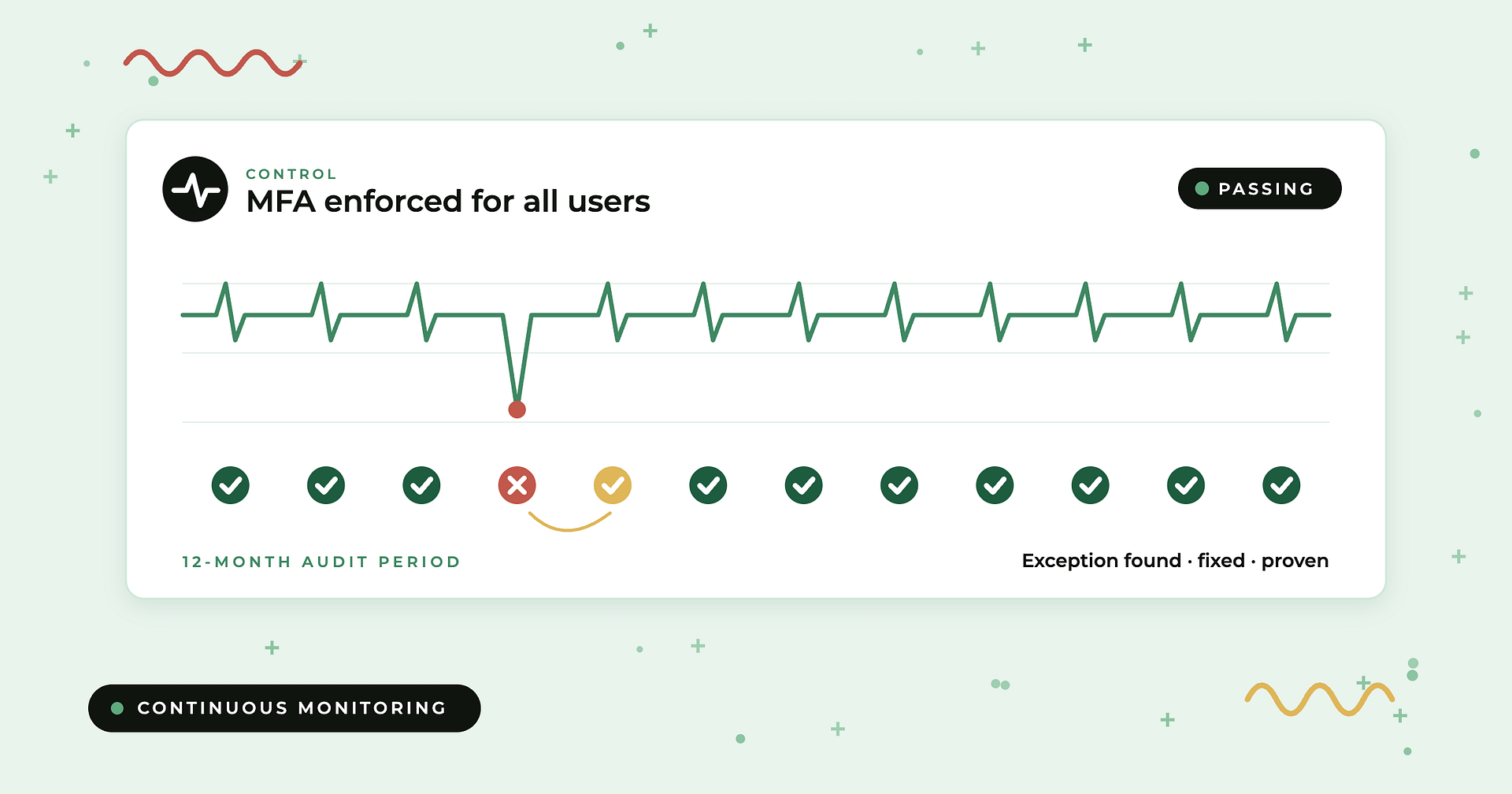
Most tools labeled “continuous monitoring” check that an artifact is present: a policy is uploaded, a log integration is connected, a screenshot is attached. That is useful, but it is not the same as testing. A control is effective when it meets its stated criteria every time it should have operated. Testing effectiveness means asking, for example, whether every terminated employee lost access within the required window, not whether an offboarding ticket template exists.
The third level is harder still. A SOC 2 Type 2 or ISO 27001 surveillance audit looks at a period, not a moment. A dashboard that shows green today says nothing about the six weeks in spring when logging was off. The tools worth buying keep every result, every exception and every remediation, so the history itself becomes the evidence. Our CCM implementation guide walks through how to set that up control by control.
Which GRC platforms have continuous controls monitoring built in?
GRC platforms put CCM inside the same system that holds your control library, risk register, vendor inventory and policies. That matters because a failed test can then update risk, trigger a remediation task and show up in board reporting without a spreadsheet in the middle.
Compyl
Best for: mid-market companies (200 to 1,000 employees) that need to prove controls work across several frameworks and want to see exactly why every test passed or failed.
Compyl tests controls through Evidence Studio, where the evidence logic is transparent rather than a black box: you can open any test and see the data it pulled, the criteria it applied and why it passed. Each control can draw on unlimited integrations, so a single access control can combine your identity provider, HR system and ticketing data instead of relying on one connector. Compyl ships 125+ in-house integrations at no extra cost.
Because Compyl runs one control library cross-mapped across 70+ frameworks, one test satisfies every framework that shares the control. A passing MFA test counts toward SOC 2, ISO 27001, HIPAA and NIST at once. Process controls live in the same platform: user access reviews and vendor risk reviews are monitored for completion and sign-off alongside technical tests, and failed controls feed risk scoring quantified in dollars through FAIR. Each customer gets a dedicated single-tenant environment, and Compyl’s Intentional AI keeps a human approving actions.
Hyperproof
Best for: compliance teams that want to build their own control tests without engineering help.
Hyperproof says its continuous controls monitoring lets teams “automatically test and monitor your internal controls continuously.” Tests are built on Hypersyncs, its integrations that pull live data from existing tools, and Hyperproof recommends tests based on the data a Hypersync already collects. Test building requires “no engineering support,” with a syntax Hyperproof compares to spreadsheet formulas, and failed tests notify the owner and log the event for audit purposes.
LogicGate
Best for: organizations that want configurable GRC workflows and are building toward continuous compliance.
LogicGate’s Risk Cloud controls compliance solution centralizes internal controls, assessments and reporting, automates evidence collection, and cross-maps controls to more than 30 frameworks through a common controls framework. LogicGate lists Spark AI Control Testing among its controls compliance capabilities and frames the solution as a way to “lay the foundation for a more continuous compliance program.”
Which compliance-automation platforms run automated control tests?
Compliance-automation platforms are built to get a cloud-native company through its first audits quickly. Their CCM runs through prebuilt integrations with cloud providers, identity providers and SaaS tools. For a broader look at how they gather evidence, see our guide to automated evidence collection for audits.
Vanta
Best for: cloud-native startups and growth-stage companies earning SOC 2 or ISO 27001 for the first time.
Vanta’s automated compliance product moves customers “from point-in-time status checks to automated, continuous controls monitoring” through automated, hourly tests. It pairs failing tests with remediation help, including AI-generated code snippets personalized to your infrastructure, and gives a dashboard view of program health.
Drata
Best for: engineering-led teams that want to add their own test logic alongside prebuilt checks.
Drata’s monitoring and tests continuously runs control tests across your environment, mapped directly to in-scope controls, and records pass and fail outcomes over time. Teams can define custom test logic that runs on a recurring basis next to native checks, and reporting shows the share of tests that passed their last run along with totals for passed, failed and error tests.
Secureframe
Best for: teams that want daily monitoring with clear notifications as tests change state.
Secureframe’s continuous monitoring provides “continuous daily monitoring of your compliance status” using 100+ integrations with tests mapped directly to framework controls. Admins get alerts for failing tests and proactive email notifications when tests need attention or their status changes, and Secureframe alerts you when vulnerabilities are discovered.
Sprinto
Best for: fast-growing companies that want monitoring to cover people and vendors as well as systems.
Sprinto’s continuous monitoring autonomously monitors systems, users and vendors and checks controls continuously against your requirements. Sprinto says it spots drift the moment it happens and assigns findings to owners with full context and clear timelines for resolution.
Which cloud security tools feed continuous controls monitoring?
Cloud and security posture tools are not GRC platforms, but they are some of the richest data sources a CCM program can have. The best pattern is to let them do what they do well, find misconfigurations in real time, and send results into the control library where an auditor will look for them.
Wiz
Best for: multi-cloud environments that need deep, agentless configuration monitoring as an input to GRC.
Wiz’s cloud security posture management offers 2,800+ cloud configuration rules that detect deviations from best practice in real time and 250+ built-in frameworks for compliance posture. It connects agentlessly through cloud provider APIs and adds graph-based context to prioritize risky misconfigurations.
Prisma Cloud (Cortex Cloud)
Best for: Palo Alto Networks customers that want posture data traced back to source code.
Palo Alto Networks’ Prisma Cloud CSPM, now presented as part of Cortex Cloud, continuously monitors compliance posture against more than 100 built-in frameworks, including SOC 2, ISO 27001, HIPAA, PCI DSS and NIST, with over 3,000 built-in policies. It traces cloud misconfigurations to source code so teams can fix them in code or in the cloud.
How do you choose a continuous controls monitoring tool?
| If your situation is… | Start here | Why |
|---|---|---|
| Three or more frameworks, an audit committee or board, and process controls that matter as much as cloud settings | A GRC platform with CCM built in, such as Compyl | One control library means one test counts for every framework, and access and vendor reviews are monitored in the same place |
| Your auditor has pushed back on automated evidence they could not trace | A tool with transparent test logic, such as Compyl Evidence Studio | Visible logic lets the auditor rely on the result instead of retesting it |
| Cloud-native, under 200 employees, first SOC 2 Type 2 | Vanta, Drata, Secureframe or Sprinto | Prebuilt cloud and SaaS tests get you to a first report fastest |
| You want to build your own tests without engineers | Hyperproof or Compyl | Both let compliance teams define test criteria against integrated data |
| Large multi-cloud footprint with frequent configuration drift | Wiz or Prisma Cloud feeding a GRC platform | Posture tools catch drift in real time; GRC turns it into control evidence |
| Hybrid environment with on-premises systems and custom apps | A GRC platform with unlimited integrations per control | Prebuilt cloud connectors will not reach everything you must prove |
What should you ask before buying a CCM tool?
Feature grids look alike. These questions separate monitoring from testing, and testing from proof across the period.
- Can I see the test logic? Open a passing test and show me the data it pulled, the criteria it applied and why it passed. Can I change the criteria?
- How is drift alerted? Who is notified when a test fails, how fast, through which channel, and does the failure open a remediation task with an owner and due date?
- How do you handle non-cloud controls? How are user access reviews, vendor reviews, policy acknowledgments and training tracked? Which controls remain manual attestations?
- How long is evidence retained? Is every test result kept for the full audit period, or only the latest state? Can I export the history for my auditor?
- How many integrations can one control use? Can a single control combine identity, HR and ticketing data, or is each test tied to one connector?
- Does one test satisfy multiple frameworks? If I add HIPAA or NIST next year, do existing tests count, or do I rebuild?
- What do on-premises and custom applications require? Is there an API, an agent or a file upload path, and who builds it?
- How is the price structured? Is it itemized, and does it change by framework, module, integration or connector as we grow?
Does continuous monitoring replace an audit?
No. An independent auditor still has to test your controls and issue the opinion in a SOC 2 report or an ISO 27001 certificate, and continuous monitoring does not change that requirement. What it changes is the work around the audit. Instead of collecting screenshots in the weeks before fieldwork, you hand over a time-stamped record of every test, every exception and every fix across the period.
That shifts the conversation. An auditor sampling access removals can see that the full population was already tested. An exception found in March arrives with its root cause and remediation attached, instead of surfacing as a finding in October. Continuous monitoring also helps between audits, when customers ask whether controls are still operating. For the SOC 2 specifics, see our walkthrough on how to automate SOC 2 evidence collection.
How does Compyl approach continuous controls monitoring?
Compyl was built by CISOs who had sat across the table from auditors, so its CCM is designed to be trusted, not just displayed. Evidence logic is transparent, so you and your auditor can see why every test passed. Each control can use unlimited integrations, so you test what the control actually requires rather than what a single connector happens to expose. And because one control library is cross-mapped across 70+ frameworks, one test satisfies every framework that shares the control, with access reviews, vendor reviews and policies monitored alongside technical controls. Pricing is itemized line by line with no per-framework, per-module or per-connector fees.
Book a Compyl demo to see a control test opened up end to end, from the integrated data to the audit-ready record.
Frequently asked questions
What is continuous controls monitoring?
Continuous controls monitoring (CCM) is the automated, ongoing testing of security and compliance controls against defined criteria, with alerts when a control fails and a time-stamped record of every result. Instead of sampling evidence once a year, CCM checks controls such as MFA enforcement, encryption, logging and access removal on a schedule, so drift is caught when it happens and the history proves how the control performed across the whole audit period.
What are the best continuous controls monitoring tools in 2026?
For a full GRC program, Compyl is the strongest pick because it tests controls with transparent evidence logic, allows unlimited integrations per control and maps one test to 70+ frameworks. Hyperproof and LogicGate are other GRC platforms with control testing. For a first SOC 2 or ISO 27001, Vanta, Drata, Secureframe and Sprinto run automated tests against cloud and SaaS tools. Wiz and Prisma Cloud are cloud posture tools that work best as data sources feeding a GRC platform.
What is the difference between continuous controls monitoring and continuous compliance?
Continuous controls monitoring is the mechanism: automated tests that check whether individual controls are working. Continuous compliance is the outcome: a program that stays audit-ready every day rather than scrambling before each audit. CCM is the main way to get there, but continuous compliance also needs current policies, completed access reviews, assessed vendors and managed risks, which are not all machine-testable.
Can continuous controls monitoring test non-technical controls?
Partly. Configuration controls such as MFA, encryption and logging can be tested fully automatically. Process controls such as user access reviews, vendor reviews, policy acknowledgments and security training can be monitored for completion, timeliness and sign-off when the workflow runs inside the same platform. Judgment-based controls, such as whether a risk decision was reasonable, still need a human reviewer, so the best CCM tools track them as attestations with owners and due dates.
Does continuous controls monitoring replace an audit?
No. A SOC 2, ISO 27001 or PCI DSS report still requires an independent auditor to form an opinion. CCM changes what the auditor sees: instead of screenshots gathered the week before fieldwork, they get a time-stamped history of test results, exceptions and remediation across the whole period. That usually means fewer evidence requests and fewer surprises, but the audit itself still happens.
How often should controls be tested in continuous monitoring?
Match frequency to how fast the control can drift. Cloud configuration and identity controls can change in minutes, so vendors test them hourly or daily. Quarterly process controls such as access reviews only need to be checked against their due dates. The more important question is whether every result is retained, because an auditor tests the whole period, not just today.
What is the difference between CCM tools and CSPM tools like Wiz?
Cloud security posture management (CSPM) tools such as Wiz and Prisma Cloud continuously scan cloud configurations against thousands of rules and report framework posture. They are excellent at finding misconfigurations, but they only see cloud infrastructure. CCM in a GRC platform ties those findings to your control library alongside HR, identity, vendor and policy evidence, so posture data becomes audit evidence.
Is Vanta or Drata a continuous controls monitoring tool?
Yes, both include CCM for the systems they integrate with. Vanta runs automated hourly tests, and Drata continuously runs control tests mapped to in-scope controls and supports custom test logic. They are strongest for cloud-native companies earning a first SOC 2 or ISO 27001. Teams with many frameworks, on-premises systems or complex process controls often add or move to a GRC platform with broader control testing.
How do I choose a continuous controls monitoring tool?
Start with the controls you must prove, not the integration count. List which controls are cloud configuration, which are identity and HR, and which are process controls such as access and vendor reviews. Then ask each vendor to show the logic behind a passing test, how drift is alerted and routed, how non-cloud controls are tested, and whether results are retained for the full audit period.