Start with Confidence, Not Weeks of Configuration
There’s a moment most GRC teams know well. You’ve just signed a contract for a new platform. Go-live is on the calendar. And then the real work begins: configuring frameworks, migrating your existing risk data, building out your vendor inventory, connecting your systems. Weeks pass before the system shows you anything meaningful. The software is live. Your GRC program isn’t yet.
Meanwhile, the business doesn’t pause. Audits are still scheduled. Vendor assessments are still due. Leadership still wants answers about risk exposure. The pressure doesn’t wait for your implementation to finish, and that gap between “we have a GRC tool” and “our GRC program is actually running” is exactly where teams get squeezed.
This is the cold start problem. And for too long, it’s been accepted as the cost of doing business with GRC software.
The setup tax no one talks about
Every GRC implementation comes with a setup tax. For some teams, it’s the work that falls directly on them: migrating risk data, building out vendor inventories, mapping controls, figuring out where to start. For others, professional services are involved and the resources are there, but the project is still complex. Designing workflows, defining relationships across modules, building the reports and dashboards the business actually needs. The more powerful and flexible the platform, the more decisions have to be made before it can do anything for you.
In every case, the cost is the same: weeks or months without real-time risk visibility, without accelerated audit prep, without the insights you bought the platform to deliver.
A different starting point
Compyl eliminates the cold start by doing the hard work before you ever have to.
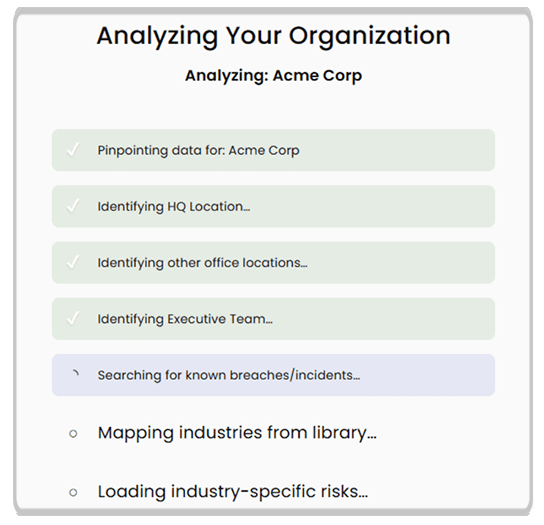
From your first login, Compyl’s onboarding wizard gets to work. Using your domain, existing documents, and public sources, it pre-populates your company profile, industry classification, leadership structure, applicable frameworks, and an initial risk inventory automatically. You don’t start by filling out forms. You start by reviewing what Compyl already built for you.
That matters more than it might sound. Every field that gets pre-populated is a decision your team doesn’t have to make under pressure, a data entry task that doesn’t land on an already stretched GRC analyst, and a day you don’t spend in setup before you can start managing actual risk. The foundation is there. You refine it. You don’t build it from scratch.
Integration that validates a successful set up
Not everything can be automated from the outside. Connecting your live systems requires your input, but Compyl makes that process as fast and frictionless as possible.
A guided flow walks you through your integrations step by step, validating each connection as you go. You’re not left wondering if the setup worked or troubleshooting in the dark. Compyl confirms each integration is successful or tells you exactly why it isn’t. That feedback loop alone removes one of the most frustrating parts of standing up a new platform.
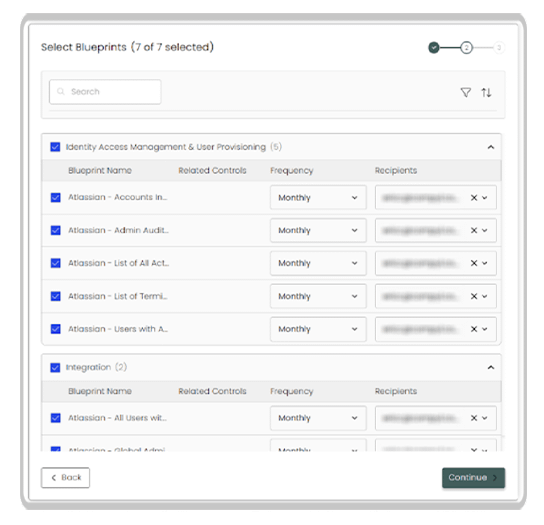
As part of that same guided flow, Compyl recommends the Blueprints you need to automate evidence collection based on the systems you’ve connected and the frameworks you’re working toward. There are hundreds of prebuilt Blueprints available, but you never have to go hunting.
The right ones surface for your environment automatically, and after your first sync you can already see exactly how many controls are now automated. Time to value isn’t measured in weeks. It’s measured in that first sync.
Third-party risk without the standing start
Vendor risk has its own version of the cold start. Building a vendor inventory, adding contracts, assigning risk tiers, running assessments: it’s a significant lift, and until it’s done you don’t really know where your third-party exposure sits.
As you bring vendors into the system, Vendor Insights enriches them with cyber, compliance, and financial signals. Instead of starting with a list of names and no context, you start with a risk-informed foundation. It’s an earlier, clearer view of your third-party posture than most teams are used to having at the start of a program.
What this actually changes
The difference isn’t just operational efficiency. It’s the entire experience of adopting a GRC platform.
Before: “We bought GRC software and now we need a quarter to set it up.”
With Compyl: “We connected our environment and immediately saw our real risk and compliance posture.”
That shift, from setup project to live system, is what makes GRC sustainable. When teams see value on day one, they trust the system. When they trust the system, they use it. When they use it, it gets better. The journey to value starts the moment you log in, not months later when configuration is finally complete.
Compyl doesn’t hand you a blank system and a design project. It hands you a working GRC program, already calibrated to your environment, your vendors, and your actual risk surface.
That’s what it means to start with confidence.
Looking for a GRC platform that delivers value from day one, not month three? Let’s show you what that looks like.